"I Want Your Sex" Is The Erotic Thriller We Deserve
The Olivia Wilde renaissance is upon us.



As I walked home from the theater last night, my brain spun with questions. You Can See Everything is billed as a documentary where you can, quite literally, see everything about Elizabeth Holmes’ life leading up to her incarceration, but it’s somehow more and less than that. Nathan Fielder and Lance Oppenheim’s film raise questions about power, finances, and what the word “truth” really means.
As could be expected by the names attached to the project, You Can See Everything is a masterclass in documentary filmmaking. The blocking, audio choices, and composition make for a film that could easily win Best Picture at the Oscars despite being a documentary. What truly sets the film apart, however, is the enigma that is Elizabeth Holmes. She is able to match Fielder’s dry delivery and stare at him so intensely I was certain they’d kiss. She’ll deliver sentences with a smile and a nod and moments later admit to being confused about what it means.
The audience was brought into her last 34 days before her 11 years in prison, and yet we know her almost less than we did before. Let’s take a look at the questions the film raised, and whether it also hinted at answers.
The following includes spoilers for You Can See Everything. I highly recommend watching the documentary before continuing. It’s worth it.
Most people, myself included, went into the theater expecting to gain a better understanding of whether or not Holmes intentionally committed the crimes she was convicted of. For her part, Holmes remains adamant that she didn’t. She told the truth. It may have been in a way that led most people to the wrong conclusion, but she didn’t intend that to happen.
It’s honestly hard not to believe her. If she’s a manipulator, she’s a master.
After hearing Holmes mince words and stare blankly when confronted with the implications, Fielder showed the Theranos founder a clip of “Who’s on First?”, an infamous comedy routine. In the skit, two announcers misunderstand each other after a man named “who” hits first base, leading to confusion about whether the second announcer is giving a question or answer. Homes pretended like it was funny, but couldn’t explain the joke. Throughout You Can See Everything, but especially in moments like this, she reminds me more of children’s book character Amelia Bedelia than a scammer.
Holmes certainly did mislead investors. The question is whether she intentionally defrauded them or if she was too naive to realize she was doing so. I prefer to give women credit, and Holmes is undoubtedly intelligent, so the latter was hard for me to buy into. Now, though, I’m either buying into her scam or she really is as trusting as she seems.
Throughout the existence of Theranos, Elizabeth Holmes was dating Sunny Balwani, the much older president and COO of the company. The two met when Holmes was 19, and it’s easy to see how a 40 year old man could manipulate her. He was more experienced in business, and he took her under his wing.
For his part, Holmes’ father believes Balwani found Holmes at a vulnerable time in her life. He says that his daughter was raped shortly before meeting Balwani, and was never the same afterwards. It’s easy to see how a vulnerable teenager might take solace in an older man protecting her and “guiding” her. Regardless of who’s guilty in the Theranos scandal, Balwani undoubtedly took advantage of a woman who was too young to know better.
Now, Holmes is engaged to Billy Evans, a man 16 years her junior the heir to the Evans Hotels fortune. Fielder suggested at the beginning of the film that Holmes was using Evans for his money—after all, a large part of the story told about Holmes is that she used her blonde hair and blue eyes to woo investors into giving up their money. Now, millions of dollars in debt, why wouldn’t she do the same to Evans? Even then, though, I was not convinced. There was something off about Billy Evans, and my feelings on that only got stronger as the film continued.
Evans refused to let Holmes or her father talk for more than a minute without him in the room. He regularly cut off interviews, changed topics, or kicked Elizabeth Holmes out of the room where Nathan Fielder and the crew were working. He always did this under the guise of “protecting” the mother of his children. However, it began to feel abusive as he continued to curtail her voice and censor what the documentary would include.
The combination of Balwani and Evans leads to a very different conclusion from the one painted in The Dropout, the hit Hulu series based on Holmes’ life. Rather than being a manipulator who is able to coax money out of men too turned on to know any better, Holmes is the one drawn to relationships where the balance of control is out of her hands.
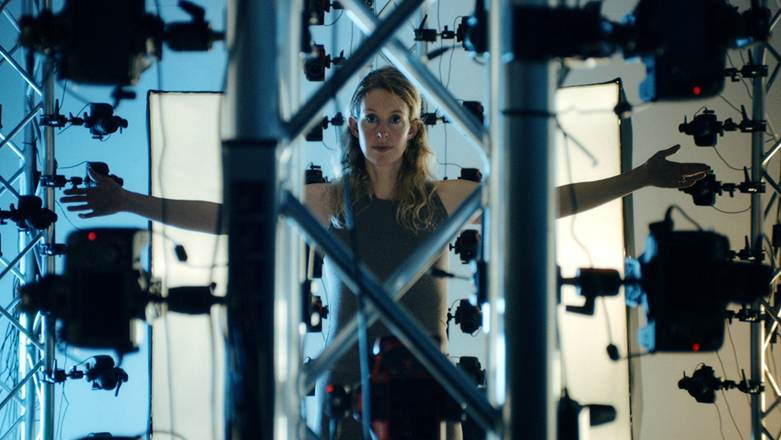
The pattern of manipulation described above is most obvious with this one fact: Billy Evans has the power of attorney over Holmes. “Power of attorney” (POA) is a legal term to describe signing over the rights to a person’s legal matters. Evans now controls all of Holmes’ finances and identity rights. This is why he’s able to log into her Twitter account, use her image to create AI videos, and sign the A24 contract without her knowledge.
Although POA is very different from a conservatorship, it gives the same privileges to the person who owns it. The difference is that in a conservatorship, the person is deemed mentally unfit. A POA is done consensually and can be revoked at any time. The ability to revoke a POA does not make it less damaging, especially for Holmes, who is in prison and relying on Evans for all of her outside information. If he really believed he would get his fiance’s consent for all of his actions using her name, he wouldn’t need legal papers to act on her behalf.
Amanda Seyfried, who played Holmes in The Dropout and reprised her role in reenactments for You Can See Everything, summed up my feelings towards Billy Evans. His energy was rancid, and he’s clearly an evil man. It’s very possible that Holmes agrees with many of the things that Evans disagrees with Seyfried and I on. However, the way he speaks about Holmes is creepy and makes me worried for her. I left the theater feeling sick. Women—no matter where they are in their life—will always be at risk from dangerous men.
Elizabeth Holmes was incarcerated a little over an hour into the three hour film, and at that point many people checked their watches. It seemed impossible that there was more to discuss, but You Can See Everything was only getting started. Nathan Fielder befriended Amanda Seyfried, both to see her reactions to the documentary and to get her help recreating scenes he was unable to get on camera.
The first time we see Seyfried in the film, it’s on another screen. Holmes, Fielder, and Evans sit down to watch The Dropout together. Holmes is clearly uncomfortable with the idea, curling in on herself and starting to cry when she sees the scene of Seyfried’s Elizabeth character talking with Naveen Andrews’ Sunny. Her emotion is visceral. She may be adamant that the show did not portray the real her, instead fictionalizing moments in ways intended to villanize her, but it’s clear that certain parts touch a nerve.
When Seyfried shows up for the documentary, she watches the parts of the film that Fielder already edited and that the audience sat through for the previous hour. She, too, is emotional at times. She’s hesitant to find honesty in Holmes’ statements but still finds sympathy for the woman and what she went through.
As the film continues, Seyfried’s sympathy grows. She meets Evans and realizes how nasty he is and how scary his assumed telekinetic bond with his wife is. More than that, Seyfried sees Holmes as a three-dimensional person. She starts believing that Holmes is telling the truth at times. She finds it harder to hold her at arms length.
No matter what the experience changed for Seyfried, The Dropout will always exist. It will always show “Elizabeth” shrugging it off when she realizes the Theranos device doesn’t work. The memes of her poor dancing will still circulate the internet. Seyfried points out that even if Holmes didn’t say those exact words, the purpose of a TV show is to capture the essence of how a person behaved. Small parts can be fictionalized as long as the general sentiment is there. They don’t know what Holmes specifically said or how she danced, but they know she saw a broken machine and sold it anyway.
There’s a very real tension in “based on a true story” work. The intention is to tell a story, but what if that story is harming a real person? Holmes has to live in a world where people know her only through Seyfried’s portrayal. Her kids will have to do the same. As is Fielder’s way, the film doesn’t directly confront the harm media might do. Instead, it pokes at it, letting the audience decide what they’ll believe.
Nathan Fielder makes the claim that documentary filmmaking is supposed to be unbiased. He is there with cameras, capturing everything that happens and showing it back to us as it occurred. That is, of course, impossible. Hours and years of footage is distilled down into a three hour film. Scenes are spliced and intercut, helping to weave a narrative.
In the case of You Can See Everything, Fielder worried that Evans’ request for backend profits would ruin the integrity of the film. It would become more reality TV than documentary, with people wondering how much of a say the subjects had in the final cut.
There was an even larger threat to the film’s integrity, and Evans was just as responsible. He made it difficult to film certain scenes, restricted access, and appeared to limit Fielder’s time with Holmes (especially once she was in prison). This led to the reliance on reenactments, where Fielder would write a script of his real life interactions and have Seyfried play Holmes’ part. This, of course, will cause bias. Fielder cannot remember everything that happens exactly, and Seyfried won’t always play every scene exactly as it was intended.
Even if the reenactments were perfect, I have to wonder about whether Fielder is capable of being an unbiased observer. He appears to have genuine affection for Holmes. He hugged her multiple times and bought her gifts, sending her “Happy Mother’s Day” texts. I mentioned earlier that I thought they might kiss during a few scenes, and I meant that earnestly. There was a tension between them that comes when two people hold unbroken eye contact for longer than anyone could possibly expect. Seyfried, too, had concerns. She thought Fielder might have censored the prison script he gave her to make sure Holmes looked good.
In the case of You Can See Everything, there’s clear areas where the film’s objectivity may be compromised. But it also opens up a larger discussion around documentaries and the way their creation is inherently pushing a viewpoint, even if the editors and directors strive to show the truth. Truth is, and always will be, in the eye of the beholder.
Holmes is currently scheduled to be transferred out of federal prison and into a halfway house in August 2027. That leaves one year between the release of You Can See Everything and her entry into the world. Perhaps then, she’ll be able to answer questions for us and provide more clarity around who she is. More likely, though, is that she’ll continue to be the enigma she always has been.
Holmes has enchanted the public with her stare, her bold claims, and her brazen confidence for years now. She was a darling when she started her company in 2003, a villain when it collapsed in 2015, and a viral sensation during airing of The Dropout in 2022. Today, she is the focus of a documentary which is selling out theaters across the country in a climate where people don’t go to theaters anymore.
Whether Holmes is actually innocent, whether or not she’s being manipulated, regardless of what happens next, one thing’s for certain: Holmes has star power. We may not be able to see everything, but we’re certainly all watching.