Media as the Evil in Eddington
Eddington attempts to capture how media is intertwined with the uncomfortable present.

After The Handmaiden and the spectacular Decision to Leave, Park Chan-wook’s new feature diverts from romance and turns to the cruel obsolescence of human labor under the evolution of machines. However, the role of romance still has an important presence in the film. The main character, Man-su, played by Lee Byung-hun, had worked in papermaking for decades, living a comfortable middle-class life with his wife, two children, and two dogs. After an unexpected layoff, Man-su was unable to find another job in the industry, and the whole family went through a financial and emotional crisis. After identifying the only suitable position in another company, he decided to take extreme measures: eliminate the original occupier, Seon-chul, of that position and other qualified candidates, Beom-mo and Si-jo.
The crisis of the unemployed men is brought forward by the people around them, especially the wives. Alternatively, the role of romance surfaced at the moment of crisis. Man-su’s wife, Mi-ri, encouraged Man-su by reminiscing about the process of them getting together. In the case of Beom-mo, the discussion of his situation between him and his wife, A-ra, and A-ra’s encouragement also evolved the story of them first meeting each other. Affected by how Beom-mo dealt with laying off, A-ra cheated on him. Man-su suspected his wife’ infidelity; Mi-ri suspected her husband’s strange routine and involvement in the disappearance of Beom-mo and Si-jo. The trust between them started to shake. During Man-su’s attempt to murder Beom-mo, A-ra impulsively pulled the trigger and eventually killed Beom-mo. Seon-chul’s wife, unwilling to live with Seon-chul in the countryside, also created a better condition for Man-su to make him drunk and capture him alone. The sexual tension appeared several times between different pairs, even when A-ra sucked Man-su’s blood out after he got bitten by a snake. At the end, Man-su’s family members, including children, became accomplices of his crime, helping him by staying silent. Families in this film function in a traditionally ideal East Asian way: men are the breadwinners, signifying the status of the whole family, and women are the bookkeepers and the emotional pillars resiliently pulling the household together at the moment of crisis.
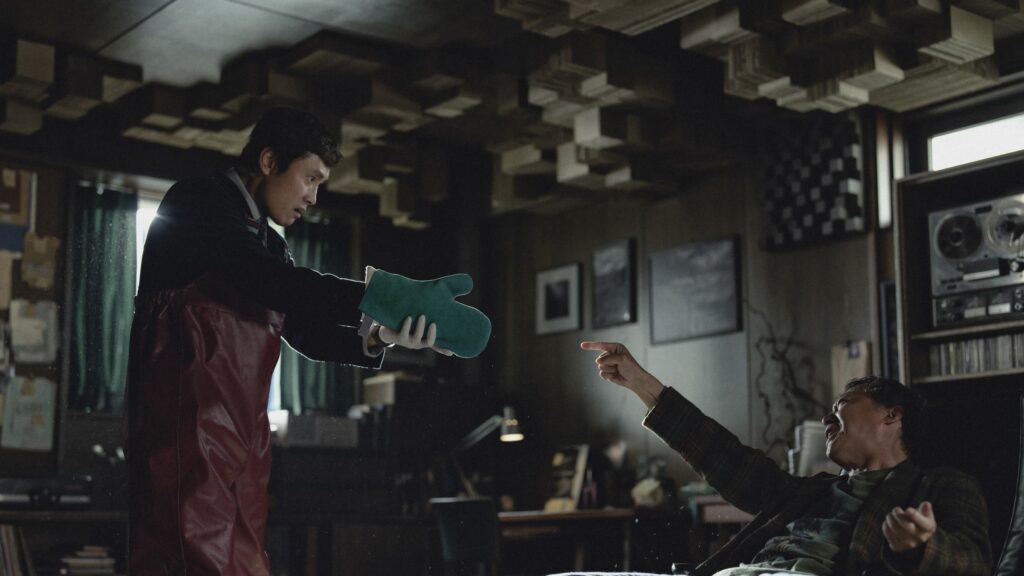
With the name “No Other Choice,” there are plenty of other choices presented in the film, other than killing. While Man-su scolded Beom-mo that he should have taken the opportunity to open a cafe, Man-su himself determined that killing is the only way out. He is willing to take extreme action to make his family happy, to keep the two Golden Retrievers, the big house with a greenhouse, the cello class for the daughter, and the Netflix subscription. In other words, he won’t let the family fall down on the social ladder. His fears for his wife’s infidelity after she returned to work also played a role. His consciousness emerged after observing the calm and kind Si-jo with his teenager and successfully convincing Seon-chul to cooperate. However, the core that supported Man-su’s behaviors is that he prioritized his own family over others’.
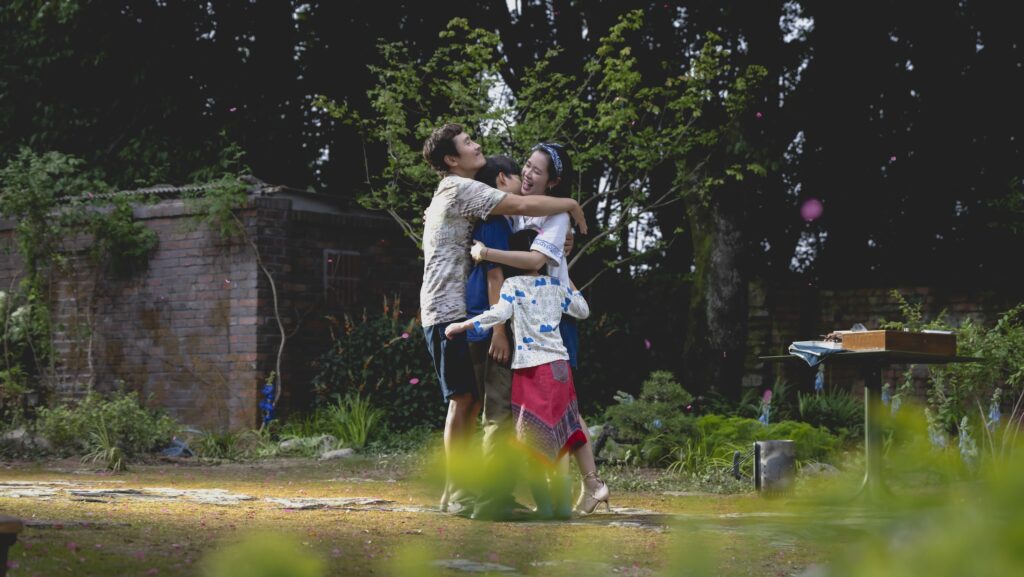
With the background of the unemployment of the Middle Ages due to being replaced by machines, the film talks more about the family bond rather than the exploitation of labor under global capitalism. We can take a look at the bleak job market by the mountain of excellent resumes Man-su received after his fake recruitment advertisement. The film showcased the wave of globalism: Man-su’s previous company was bought out by Americans, and his new employers are run by Chinese. With the usage of paper dying down, the papermaking industry is also a symbol of obsolescence in the digital age. Yet, these remain as background information, and the main suspense is the dynamic within the family since the hug at the beginning. Park Chan-wook’s signature shines through in this film’s cinematography and editing. The dissolve effects and apparent changing of focal lens have a strong presence. This film also massively integrates phone and tablet screens into the visual and the narrative of the film, especially video calls. However, there is a distance between the amazing spectacle and the theme, despite the clear connection at the core of modern technology.
At a masquerade Man-su and Mi-ri attended, Mi-ri dressed as Pocahontas with a stereotypical costume, and Man-su dressed as John Smith, because that’s their and their daughter’s favorite romance. Mi-ri referred to the costume as “Indian” style. This out-of-place side story fits into the limited and closed-off worldview of this couple. With the green-blue color palette and the smooth visual of the interior designs, the film’s tone leans to fantasy, adding to this film’s theatrical essence, cutting it off from the others’ struggle in the world. In the last scene, Man-su waltzed into an empty, human-less paper mill with an orchestra of machines. Cutting between different scenes of automatic machines without humans, like the giant iron claw cutting down trees, the tragedy is finally stated through these shots—the obsolescence of humans. This characteristic final chapter articulates and materializes the theme of unemployment in the age of obsolescence, creating an emotional climax of catharsis.