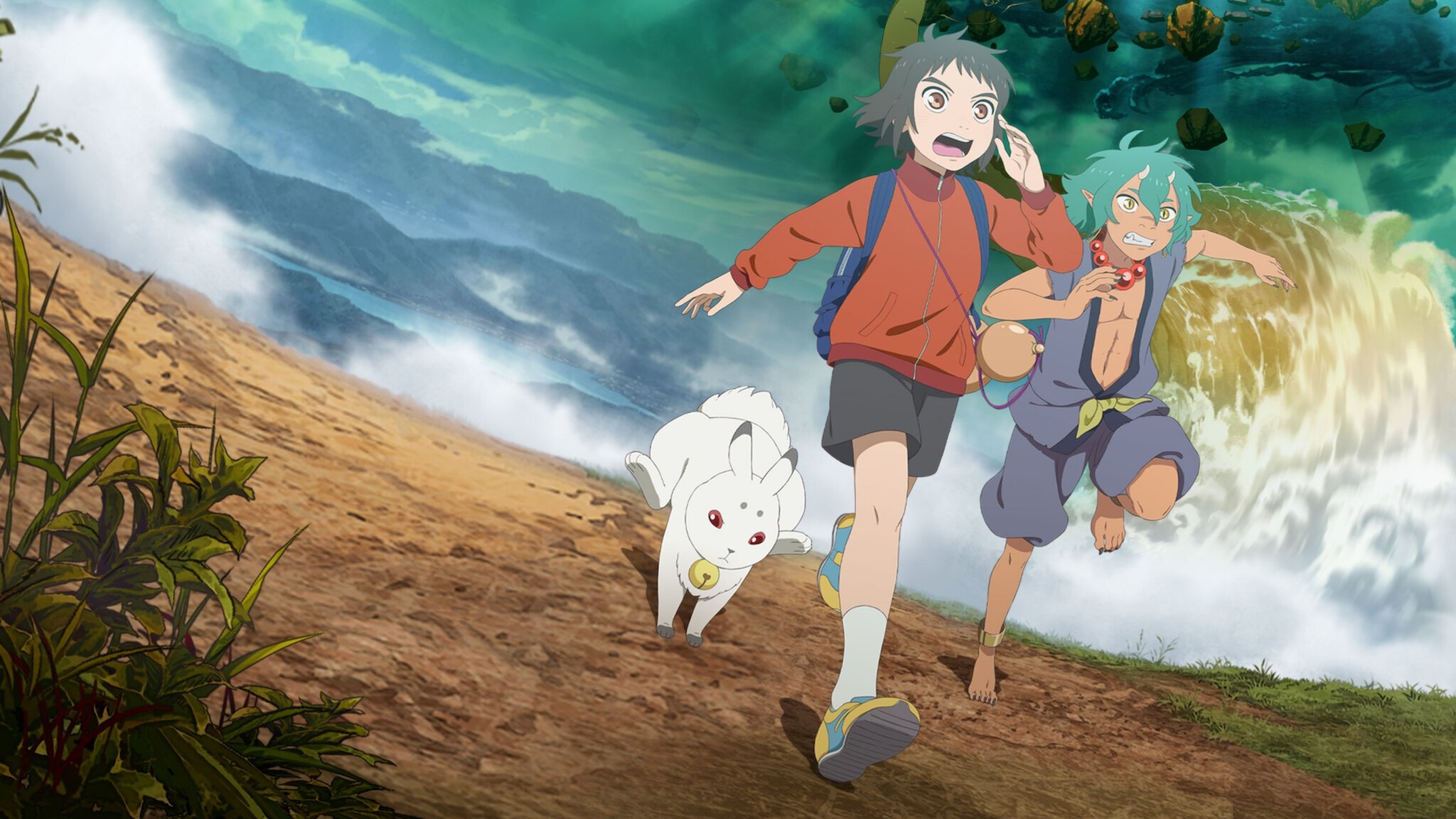
Child of Kamiari Month is a 2021 Netflix anime movie that is about a young Japanese girl, Kanna (Aju Makita). After losing her mother, she journeys across Japan to the sacred land of Izumo. This film has a strong representative cast consisting of Japanese actors.
The film opens with a scene of Kanna chasing her mother through a forest. The background music is a soft piano, slowly fading away as Kanna calls after her mother, "Mom, don't leave me!" The scene changes to white and fades into a classroom, indicating to viewers that this is all a dream.
The class lecture about the gods of Izumo foreshadows the main plot. The bunnies in the pen symbolize companionship; Kanna talks to her pet bunny when she is alone. When Kanna arrives home, she looks at the framed photograph of her mother; she feels the emptiness inside her because it's been one year since her mother passed away. One scene where Kanna is crying for her mother in the rain emphasizes this emotion. Kanna is determined to find out why her mom disappeared suddenly.
Child of Kamiari Month combines realistic elements and fantasy elements. The setting takes place in Japan and plays an important role in Kanna's quest. The transition from reality to fantasy is indicated by the frozen time-and-space elements triggered by a magical green stone on Kanna's bracelet. The bubbles are frozen in the air, something only Kanna notices. The amulet symbolizes power and control over time and space.
Kanna is surprised to see that the pet bunny she encountered in the bunny pen can talk. The bunny happens to be an assistant to the gods of Izumo and tells Kanna that her mom was also part of the gods. Her mother was also a runner. In fact, the movie's title, Child of Kamiari Month, gives viewers a clue about Kanna's identity.
Kanna's tasks on her quest are shown through animated 2D drawings in colored pencils. As Kanna goes on her quest across Japan, she is slowly following in her mother's footsteps by running on her own two feet. She eventually becomes a stronger runner. She learns that magic is the power of the gods. She meets the gods, who are beings in the form of magical animals.
There are flashback scenes where Kanna is with her mother; this is indicated by the brightness and rainbow colors on the screen. The flashback switches to a black-and-white scene where Kanna sees her mother on her deathbed.