Everyone’s Welcome in IT: Welcome to Derry
It: Welcome to Derry proves you can have rich representation, real humanity, and still fully enjoy Pennywise terrifying kids in sewers.


Who Gets to Exist in this Mystery, and Who Doesn’t?
Watching Wake Up, Dead Man feels like being invited into a familiar room that’s been rearranged just enough for you to enjoy yourself. The film is sleek, controlled, and deliberately paced, the kind of mystery that wants you to feel smart for keeping up. It’s confident in its construction, careful with its reveals, and clearly proud of its lineage. And if you are a fan of the Knives Out series, you will enjoy it.
The plot itself is perfectly teased: a death, a small circle of suspects, and the slow tightening of moral pressure as secrets surface. Even without diving into specifics, the setup signals a story about power, performance, and truth, themes that naturally invite questions of inclusion.
The bigger question is whether the movie’s polish leaves room for everyone, or whether some people are only allowed to exist as narrative furniture. I enjoyed watching it. I just wasn’t convinced it wanted everyone watching to feel equally welcome.
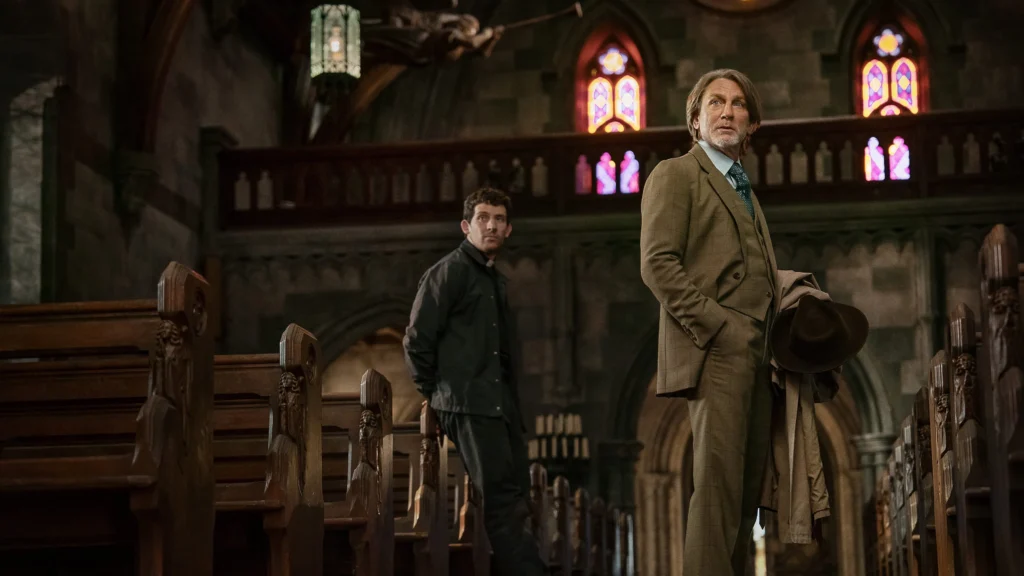
At its core, Wake Up, Dead Man is a story about people protecting their external versions of themselves and how they are viewed (or perceived to be viewed), set against the backdrop of an impossible crime in a rural church. The mystery begins when Monsignor Jefferson Wicks, the dominating spiritual leader of his congregation, played realistically well by Josh Brolin, is found dead during a service.
Into this tightly knit world comes the famous Benoit Blanc, Daniel Craig as our charismatic detective with a new hairdo. Fans clearly recognize Blanc from Knives Out (2019) and Glass Onion (2022). Here, our beloved protagonist is now tasked with unraveling a case that blurs faith, ritual, and suspicion.
Father Jud Duplenticy (Josh O’Connor), a young priest with a complicated past, quickly becomes both Blanc’s reluctant ally and the community’s prime suspect.
Surrounding them is a colorful ensemble played by popular veteran actors from the devout Martha Delacroix (Glenn Close) to local doctor Nat Sharp (Jeremy Renner). Rounding out the cast is Police Chief Geraldine Scott (Mila Kunis), best-selling author Lee Ross (Andrew Scott), and the other parish members whose own ambitions and secrets complicate the search for truth.
Rather than relying on the many enjoyable twists, the film lets conversations and interpersonal power shifts do the work. However, what’s most noticeable isn’t just who did it, but whose identities are heard, and whose are silenced.
This is where Wake Up, Dead Man quietly draws its lines. The film is generous with depth for characters who already carry social authority within the story. These figures are allowed contradictions. They can be charming and cruel, intelligent and cowardly. The movie lingers on their motivations, trusting the audience to sit with discomfort.
Other characters, however, function more as signals than as people. They exist to indicate diversity, tension, or moral contrast, but they seem completely disinterested in their own identities and exist to be nothing more than a suspect. You learn what they are motivated by faster than you learn who they are, as their inner lives are explained rather than explored.
The result is a film that looks inclusive on the surface but distributes narrative empathy selectively. Inclusion here is present, but uneven. Visibility does not always translate to agency, and that is my complaint.
Wake Up, Dead Man draws its clearest lines around authority. Monsignor Jefferson Wicks is given the fullest narrative weight, even in death. His influence hangs over every character, shaping behavior, fear, and loyalty. The film understands him as complex, controlling, charismatic, and morally compromised, and that complexity is treated as worthy of examination.
By contrast, Father Jud Duplenticy, the priest reassigned to the parish because of his past, occupies a more precarious position. He is visible, central, and emotionally charged, but also framed through suspicion almost immediately. The film allows him vulnerability yet keeps him under a microscope in ways other characters never experience. His interior life exists, but it is constantly questioned.
The local parish orbit includes figures like Martha Delacroix, Dr. Nat Sharp, Samson Holt (Thomas Haden Church), and the rest, all of whom function as a social ecosystem rather than a collection of fully equal voices. Some are granted moments of agency and contradiction. Others serve as extensions of the institution itself. All, however, give outstanding and believable performances, nonetheless.

The imbalance of representation becomes noticeable with the characters of Vera Draven, played by Kerry Washington, and her adopted son Cy Draven, played by Daryl McCormack. These two are the film’s only characters of color. Both are clearly embedded in the mystery, tied directly to the church, its finances, and its moral compromises. We are made aware that they want something, and that those wants matter to the outcome of the story.
What the film withholds, however, is depth. Their motivations are presented as facts that carry the narrative along more than complex histories. We see intention with little interiority, action with minimal emotional excavation.
A similar tension surrounds the lone disabled character Simone Vivane, played by Cailee Spaeny. The film treats her with sensitivity and avoids exploitation, but it also keeps her at the margins. Her disability is acknowledged respectfully, and we understand what motivates her, yet her perspective is rarely allowed to drive the story forward.
Everyone belongs in the room. However, authority still decides who gets to speak the longest.
The blind spots in Wake Up, Dead Man are subtle. The film is comfortable naming corruption, but less comfortable exploring how that corruption is experienced by those with the least institutional protection. When tension rises, the narrative often re-centers authority figures rather than those most affected by their decisions.
The local gang and secondary parish members are never caricatured, but they are also never fully invited into the story’s emotional core. Inclusivity here operates on access rather than power. The film avoids offense, but it also avoids risk. That choice keeps the mystery elegant and controlled, while quietly limiting how far its critique into culture can go.
Wake Up, Dead Man will resonate with viewers who enjoy character-driven mysteries that interrogate power without abandoning polish. Fans of Benoit Blanc’s previous cases will find continuity, wit, and a familiar moral lens.
Those looking for a mystery that fully hands narrative authority to marginalized characters may find the film restrained. Some viewers will feel seen. Others may feel carefully acknowledged but not centered.
The movie is worth watching, and is entertaining and compelling as ever. Its inclusivity enhances the experience but also defines its ceiling. It invites you into the room, just not all the way to the suspects table.