“Primetime” and Emptiness
This is not McDonald’s. This is something different.



I am a man. I have a fragile ego. When people point this out, I get upset. This, in addition to being a series of true statements, is the essence of the concept of male fragility. Not all men have fragile egos, but enough do that it seems to be a pretty universal experience that women have to deal with. This concept is explored (interestingly, by a male director) in The Sun Never Sets.
The plot revolves around a few characters, but four are worth mentioning for this article. Dakota Fanning plays the main protagonist, Wendy. She is caught between three men: Jack(Jake Johnson), her most recent partner, Chuck(Cory Michael Smith), her (ex?) boyfriend, and to a much lesser extent Brad(Brandon Daley), who has a huge crush on her. All three have central sins. Jack’s sin is constantly changing his mind and sending mixed signals in a way that could be avoided if he just calmed down and thought through his emotions. Chuck’s sin is not being open and honest with his partner and hiding things like his bad credit score, as well as some alluded-to bad behavior that lead to the first breakup. Brad’s sin is, well, he’s he’s kind of like Bear from Obsession if he never got his hands on the one-wish willow. Another movie, directed by a man, that deals with men not handling their own emotions and, as a result, hurting women.

Without having any actual evidence, I think this movie is meant to leave you frustrated and unsatisfied. Not with the movie itself, but with the actions of Wendy. She constantly goes back and forth, ping ponging from man to man, mostly between Jack and Chuck with a tiny sprinkling of Brad at the beginning. Spoiler alert, but she never actually just cuts everything off with these men. There are numerous points, most notably during a trivia night, where the audience is lead to believe she is finally just going to be single and not deal with all these toxic men in her life, but usually dumping one often leads to picking one back up. The question becomes, is this a reflection of what sometimes happens in real life? Or is it a man trying to give at least one of the male characters a redemption without forcing him to earn it?
Another creative choice that deserves some analysis is the choice to make Wendy flawed in a similar way to these three men. There is never any question that Wendy is the hero, surrounded by emotionally mediocre males. But in addition to her constant returning to their embrace, she also is prone to some of the same mixed-signaling, lack of honesty, and awkwardness that Jack, Chuck, and Brad are guilty of, respectively. But crucially, where the men do these things based on their inability to handle their own emotions, Wendy does these things based on her inability to handle other people’s emotions. Those emotions are thrust upon her during such a tumultuous time, and the source of those emotions are also the cause of her emotions, so it’s nowhere near fair to call her “toxic” or “fragile” because the context of her actions is completely different. That being said, one wonders if the man behind this movie also made a subconscious choice to try to balance the film and make the men look less guilty in comparison.
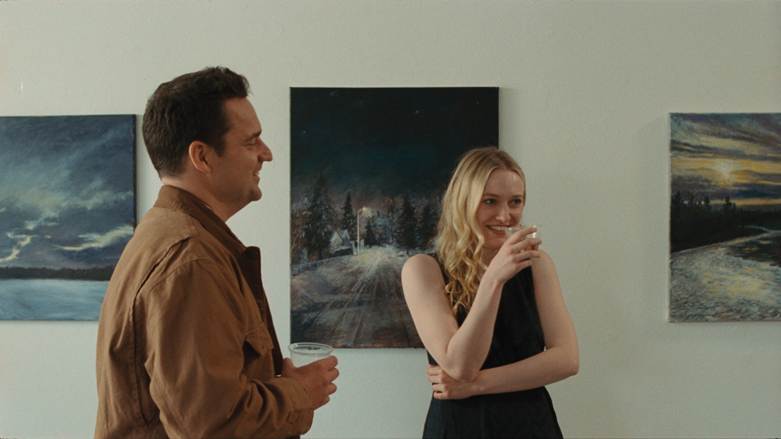
“The man” who has been namelessly alluded to in this article, who directed, wrote, and edited this film. is Joe Swanberg, known for his collaborations with directors like Greta Gerwig and Adam Wingard. This film shows off his ability as a director to, on a very small budget, capture pedestrian settings in a way that is both relatable and visually compelling, similar to films like Sentimental Value and Manchester by the Sea. It also shows off his ability to direct a cast to act so convincingly that it gives the audience the desire to lead into the movie screen and shake the characters for their dumb but realistic choices.
This is a very competently made film that deserves to be seen. It is engrossing, engaging, and impressive, especially for its financial limitations. If this movie was released in the days when Chasing Amy was seen as progressive, it would also be seen as surprisingly progressive. Maybe it still is by today’s standards. Never should it be implied that a man shouldn’t try to direct a feminist film, and for the most part, Joe Swanberg seems to pull it off. That being said, one can’t help but wonder if he would have been helped by co-directing it with a woman, like he has done before in the past.