The Secret Agent Remembers the Absent Memory
The film reminds us to remember the people who had the courage and dignity that had made the world better, even when the memory was absent.


This new space sci-fi film has earned a fair amount of attention and applause with its comedic charm. With communicating with aliens being a major theme, the Project Hail Mary doesn’t sufficiently explore the possibility of languages. A not-so-short period of screen time depicts the detailed progress of how the protagonist, Grace(Ryan Gosling), became able to communicate with the alien, Rocky. Grace cleverly picked the universal language of mathematics as the initial bridge, but it’s an unmoving clock with 12 numbers that finally broke the ice and made the progress—the 12-hour rotation that means nothing on other planets.
Subsequently, the advanced translation program that Grace built seemed to operate live interpretation with little or no delay. However, it’s hard not to notice that this advanced machine couldn’t cross the mere limit of English: it can’t put the subject, verb, and object into the correct order, and it can’t directly translate the sentences with the word “question” at the end into a question. It’s an inconsistency that the program can translate sentences in different tenses, yet it can’t do the basic tasks that regular translation apps can do when they translate other human languages into English. While the abstract information was shared by the two parties, it’s an obvious attempt to remind the audience from time to time that Rocky spoke a language distinct from humans.
I can’t help but think about Story of Your Life by Ted Chiang, which is also adapted into film (Arrival by Denis Villeneuve). In that story, the limit of human language is explored, and it experiments with the concept of determinism. Therefore, the logic of the alien language is fundamentally different there. The magic of linguistic aspects is easy to look past for the hard science fiction works.
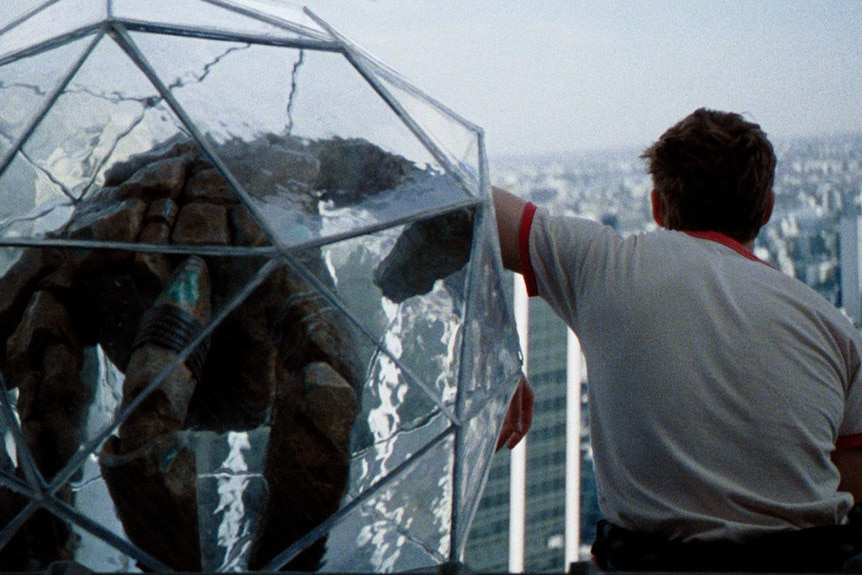
Grace doesn’t have a traditional background as a researcher, which interestingly led him to pose as a bystander standing out awkwardly. This also made the breakthrough of this project often based on a “Eureka” moment. The main plot of this film, however, is prone to highlighting the realization that Grace is not voluntary about boarding this heroic mission. The motto is even though lacking the ambition and the initial courage, a man with kindness in his heart still can do good and spectacular deeds. Before the reveal, it’s expected for Grace, with his characteristic focus on being average and easy to relate to, to refuse to participate in the suicidal mission with such an immense responsibility. There was no personality arch for Grace, so it fell short on emotional impacts.

The global crisis presented in the film smoothly brought up a fantasy of world peace. Facing the outer world threat, all of the conflicts and competitions between nations naturally dissolved and became inner problems. It suggested an equality with requirements: individuals from different countries could become equal, as long as they brought intelligence to the table. In the meeting, scientists spoke in different accents. Selected astronauts were from the US, China, and Russia, which was visible from the national flags. German actress Sandra Hüller and Asian American actor Ken Leung had a short interaction in Mandarin as a way to show being smart or versatile, in contrast to clueless Grace. The cultural differences became superficial and rootless traits.
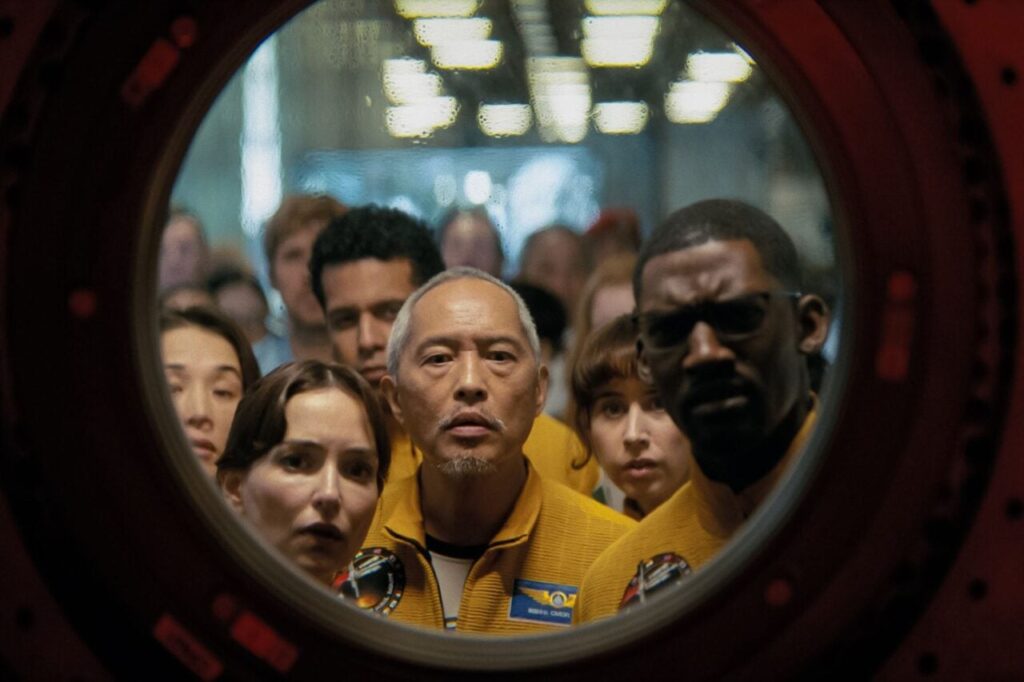
The fantasy comes from a satisfaction of gathering capital and imperial power, limitless resources, and intelligence. This gesture was extended to Rocky and its civilization. Especially, they provided information and technology, and their personality traits can be associated with a childlike quality in humans, which makes them likeable and human-like.
Eventually, the goofy and adorable Grace, a white American man with not much research background, succeeded in the mission. On the surface, the film has its non-linear narrative to reveal a secret, a neat set design with a splash of Grace’s chaotic energy, and Hüller’s surprising karaoke number. Digging deeper, there wasn’t something that went to outer space in the emotional, moral, or intelligent aspects. Regardless, the glass, metals, cool sweaters, and the bronze tint in Rocky’s spaceship are still pretty to look at.