I “Hope” You See This Movie
Hope has great characters, inventive ideas, an incredible imagination, a palpable intensity, and numerous other aspects that make it one of the best of the year.



Stephen Spielberg recently garnered controversy for claiming that his new film Disclosure Day would cause Christians to ask questions about their faith. Whether that prediction will end up true or not, there is another ideology that we should be questioning in light of this film. That being anthropocentrism, the often-unconscious belief that human beings are central in the story of the universe.
That way that this film is anthropocentric isn’t necessarily obvious, until it smacks you in the face like a car driving another car into a train. In a film that is entirely centered around the existence of aliens, the aliens play almost a bit part in the movie. One realizes that this film isn’t about aliens, it’s about humans who are motivated by aliens. The aliens aren’t the center in the movie, they’re merely the driving force behind the real center, the human characters.
Disclosure Day talks up its extra-terrestrials as supreme beings of high intelligence who use math to communicate, even orally. One would think that such an interesting species would take center stage. Maybe it could make sense to say, because the audience is human, the protagonists should be human to be relatable, or maybe that it’s interesting to explain the human perspective. But Stephen Spielberg himself has already made films like Close Encounters of the Third Kind, E.T. the Extra-Terrestrial, and War of the Worlds, all films that focus heavily on the human perspective and all films that Disclosure Day borrows from. This doesn’t even take into account the myriad of other films about aliens made from the human perspective. One would think Mr. Spielberg would be interested in making a film that not only features aliens but is also about aliens.

The urge to constantly make humans the centerpiece likely falls from the urge to make ourselves the center of a narrative. This is the driving force behind properties like Harry Potter, Superman, and Lord of the Rings, where main protagonists are intentionally crafted to be vicariously lived-in by the viewer. We like to see ourselves in central roles. More nefariously, this causes storytellers to disproportionately assign traits that either the creator or the audience has, most notoriously ethnic identity. The same urge that causes filmmakers like Stephen Spielberg to succumb to anthropocentrism also causes numerous creatives to fall to Eurocentrism and male-centrism, and in general center their stories around dominant socioeconomic groups.
Why else would a film about the disclosure of the existence of aliens take place in the area of Kansas City, the center of the United States, and feature a cast of largely white people? Of course these are not inherently evil acts, but it doesn’t help the story either. At best, it helps a target audience of white Americans relate to the film, and at worst, it projects an unconscious belief that “we” are more important than others. In a film that seeks to question the centrality of humanity in the universe, it seems that not only humans, but white humans, are pretty centralized.
There is certainly an attempt to use this relatability to make us ask the same questions that the main characters do. But then why must the two humans with alien-born superpowers be white, young, attractive, neurotypical people? It’s not that this choice is inherently wrong, it’s that this is such a common trope that a person as imaginative as Stephen Spielberg should have the spark to give us something more expectation-defying. More to the point, it selfishly, if unintentionally, assigns exceptionalism to dominant subgroups.
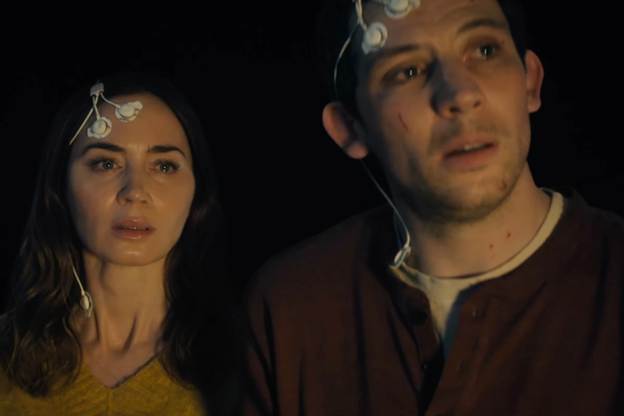
There is at least some diversity in this film. Colman Domingo, who is of Belizean and African-American heritage, turns in another standout performance in a career full of them. There is a smattering of other Black characters in the film, but they play minor roles. Even Domingo’s character Hugo mostly exists to help the white characters on their journey, though he does have at least one major monologue in the film. A spinoff about his character would be interesting.
Of course, none of this is meant to detract from the fact that this is a pretty darn good movie. It weaves multiple storylines together beautifully and keeps you guessing. Disclosure Day excites the audience and shrouds the subject matter in just enough mystery to make you feel like you know more than the average person but not as much as the main protagonists. While not every instance of VFX makes the landing, when it does, it seriously impresses. Emily Blunt, Josh O’Conner, Colin Firth and others put their best into the material. Disclosure Day is structured very well and I recommend it. That being said, we should not pass-up the opportunity to have a meaningful conversation about the biases that exist in how we tell our stories.