
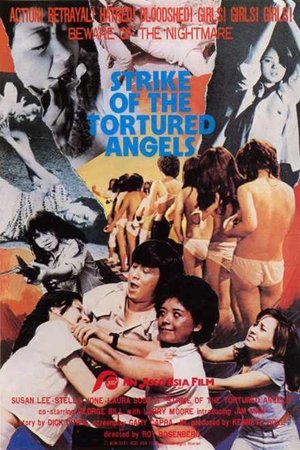
Strike of the Tortured Angels
Julia, aged 18, kills her sister by pushing her from the 12th floor; and at the discotheque, she hits her classmate's head with a beer bottle. Julia is arrested and sent to the Girls Rehabilitation Centre where she is tortured and savaged by the guards. The film was originally a Korean movie from 1974 titled "Julie, a Half-blood" (https://www.kmdb.or.kr/eng/db/kor/detail/movie/K/02793), released 10 years later as a HK movie with fake credits.

- / 5
PopScore
Representation
Pictures and Videos

Movie Information
Julia, aged 18, kills her sister by pushing her from the 12th floor; and at the discotheque, she hits her classmate's head with a beer bottle. Julia is arrested and sent to the Girls Rehabilitation Centre where she is tortured and savaged by the guards. The film was originally a Korean movie from 1974 titled "Julie, a Half-blood" (https://www.kmdb.or.kr/eng/db/kor/detail/movie/K/02793), released 10 years later as a HK movie with fake credits.
Rating:
Genre:Action, Horror, Crime, Comedy
Written By:
In Theaters:
Box Office:
Runtime:80 minutes
Studio:Asso Asia Films, Shin Brothers Motion Picture Company
Cast


Articles You May Like
For Rowena, Today Is 'Christmas Again?!'
For a young girl who wishes to keep her current traditions, this holiday will end up with a surprise twist.
'The Half of it' Handles its Presented Social Issues Thoughtfully
The social issues The Half of it takes on are handled well, between the antagonization brought on to Ellie for her race and the conflict that arises from her being gay. Both aspects of her character are built up over the course of the film and don’t seem abrupt or rushed. The film shows racism towards Ellie and her and father in varying levels, from having her schoolmates specifically address her as "Chinese girl” to the fore mentioned way her Dad is treated due to language barriers. The same can be said about Ellie being a lesbian. While she never truly “comes out” in the narrative, that does not undermine her journey of self-discovery from being meaningful. These ideas aren’t thrust upon the viewer in a preachy manor, the scenarios that occur feel believable given the rural setting. The film presents watchers with problems whom those like Ellie may face, and leaves us to sit with them and reflect.
Freakier Friday: Maybe It Was Freaky Enough the First Time?
If a movie about a strange and crazy day is commercially successful, why not recycle it and double the kookiness quotient? That seems to be the logic behind this followup to Freaky Friday.
An exploration of societal expectations and madness: Die My Love (2025)
It’s been awhile since I’ve seen a film that is jarring within the first five minutes. Being at the edge of my seat from the very beginning made me feel both excited and frightened for what was to come, and it did not disappoint. Led strongly by Jennifer Lawrence as Grace, a woman trapped in the “American dream”, this film shows that society tells us what should make us happy. Many critics describe Die My Love as being about post-partem depression, but it is so much more. After moving to a secluded home with her husband Jackson, Grace finds herself in the throes of motherhood. Feeling isolated in her physical environment and her romantic relationship, Grace suffers psychologically. Lawrence brings a sense of rawness and humor to the screen that is often uncomfortable. Robert Pattinson adds to the discomfort as her loving, yet lost husband Jackson, who cares about his wife but does not know how to help her. Lynne Ramsay has presented a film that forces us to look at the realness of life, and what happens when the promise of what should make you whole fails.
Deep Cover: fun, but not that deep
The more biting satire is reserved for those on top of the power structure, such as the police, while those occupying lower levels are given more nuance and likability, even if they operate on the wrong side of the law. This principle gives Deep Cover its heart.