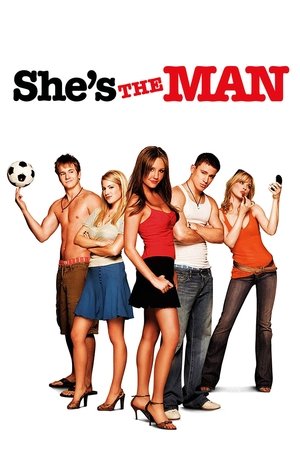
Remember Livestrong bracelets? Flip phones? The All-American Rejects? Luckily, one could find each of these distinctly mid-2000's characteristics inShe’s the Man, a 2006 gender-swapping Amanda Bynes teen flick. She’s the Manis now fifteen years old, and what’s even harder to believe is the idea that it aged surprisingly well for a comedy. Most of the film’s faults were present in 2006, such as the confused messaging, and it was clear even back then that Amanda Bynes improved the comedy of this screenplay. But what makesShe’s the Manintriguing all these years later is its feminist gender-bent premise and the queer subtext that comes along for the ride, and how strongly it all holds up. She’s the Manis no groundbreaking piece, but these conversations (as well as its leading performance) make this nostalgic comedy worth revisiting.
Loosely adapted from William Shakespeare’sTwelfth Night, She’s The Mantells the story of Viola, a tomboyish soccer player and high school student at Cornwall Prep. When the school cuts the girls’ soccer team, Viola tries to convince the boys’ soccer team coach to let women play on the boys’ team. The coach rejects the idea, stating, “Girls aren’t as fast as boys, or as strong, or as athletic. That’s not me talking; it’s a scientific fact. Girls can’t beat boys.” The boys agree, including Viola’s boyfriend Justin, who fails to defend Viola’s position. Viola breaks up with Justin and decides to make herself over to look like her twin brother Sebastian, who is enrolled at the neighboring Illyria Prep but skips town to go to London, England, to play at a music festival. Viola plans to take Sebastian’s place at Illyria Prep and join their soccer team, which happens to be Cornwall’s archrival.
Viola shows up to Illyria with a comedically lower voice, a wobbly “male strut”, anda wig and sideburns to match her brother’s hair. As Sebastian, Viola enters her dorm room to find her roommate, a shirtless Channing Tatum in grey sweatpants named Duke Orsino. Hilarity ensues as Viola faces one obstacle after the other pretending to fit in with her muscular male cohorts; having to shower when everyone is asleep, having to change clothes when no one is around, and passing off her tampons as a nosebleed hack.