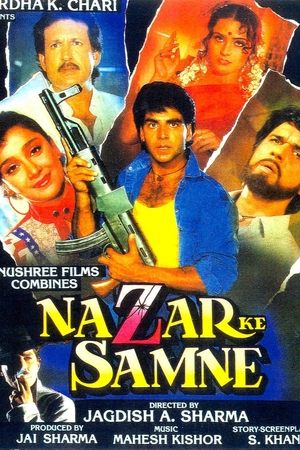
Nazar Ke Samne
Umesh is accused of killing a newspaper editor. His wife and mother hire a reputed lawyer named Sangram Singh Sahni, who agrees to be the defense lawyer without charging them any fees. The case is going in Umesh's favor, until a young man named Jai Kumar, comes as an eye-witness and states that he has seen Umesh commit the murder from his balcony right opposite the venue of the murder. Umesh is convicted and sentenced to death. Umesh's sister, Sarita, finds out that Jai was paid to lie, and she approaches him to change his testimony. He refuses, but subsequently relents when he finds out the havoc he has caused in their lives. He approached Advocate Sahni, who attempts to do his best to get a new trial, in vain, though and Umesh is set to die within one week. Now Jai must come up with the person who really killed the Newspaper Editor, and the only clue he has is a photograph of the killer's shoes...

- / 5
PopScore
Representation
Pictures and Videos

Movie Information
Umesh is accused of killing a newspaper editor. His wife and mother hire a reputed lawyer named Sangram Singh Sahni, who agrees to be the defense lawyer without charging them any fees. The case is going in Umesh's favor, until a young man named Jai Kumar, comes as an eye-witness and states that he has seen Umesh commit the murder from his balcony right opposite the venue of the murder. Umesh is convicted and sentenced to death. Umesh's sister, Sarita, finds out that Jai was paid to lie, and she approaches him to change his testimony. He refuses, but subsequently relents when he finds out the havoc he has caused in their lives. He approached Advocate Sahni, who attempts to do his best to get a new trial, in vain, though and Umesh is set to die within one week. Now Jai must come up with the person who really killed the Newspaper Editor, and the only clue he has is a photograph of the killer's shoes...
Rating:
Genre:
Written By:S. Khan
In Theaters:
Box Office:
Runtime:134 minutes
Studio:
Cast




Articles You May Like
Knives Out: Sharpest Writing of 2019?
Knives Out doesn’t just defy the whodunit narrative, it uses the weaknesses to its advantage. It’s well aware of the genre’s faults and tropes
"The Father" Movie Review
Trans Allegories in Film: 'Shrek' (2001)
Films can alleviate alienation by presenting realities where the viewers feelings are shared by onscreen characters. The film 'Shrek' can be interpreted as a transgender story.
Why 'G.B.F.' (2013) is Pretty Good, Actually
The “gay best friend”, an age-old trope, has been done in countless films and television series. Ranging from one-note (Sex and the City's Stanford and Mario) to nuanced (Unbreakable Kimmy Schmidt's Tituss), the gay best friend exists to support and advise the main protagonist, with their conflicts swept to the side.
Revisiting the Holy Trinity of Aroace Disney Princesses for Pride Month
Although not canonically aromantic or asexual. the stories and personalities of these Disney princesses resonate with members of the aroace community.