“Dreaming Whilst B\@*k”
Masterful satire that shines a light on the struggles of Black creatives.

When I was a cook, people would send their food back to the kitchen sometimes because it didn’t meet their expectations. The same can be said about filmmaking. Movies often fail because of bad marketing. Such is the case with ‘Slanted’. The short trailer and descriptions probably had people expecting a horror/comedy. Trust me. There’s nothing humorous about this film.
If you liked ‘Get Out’, ‘Slanted’ is on another level showing the perspective of ‘Joan Huang’ (Shirley Chen), a Chinese adolescent wishing to be White. Desperate to fit in with her high school classmates, she goes through the gamut of bad decisions trying to fit in. This culminates in undergoing “ethnic modification” which doesn’t just change her skin tone or the shape of her nose but alters her DNA and transforms her into another person(McKenna Grace).
It’s only fitting the clinic where she receives the procedure is tucked away behind an old Afrocentric barber shop. She walks past the sketchy storefront and emerges into a bright, well-lit waiting room where she meets ‘Willie Singer’(R.Keith Harris), a middle-aged White man and the inventor of “ethnic modification”.
This is probably where the misperception of ‘Slanted’ being a comedy comes in. As ‘Willie’ describes this sci-fi-esque procedure, he has a demented smile which shows up in the trailer. With no context, it looks comedic. Almost immediately after her the procedure her face begins to deteriorate - hence the horror.
During the second half of ‘Slant’, ‘Jo Hunt’ slowly begins to realize being White isn’t what she thought it would be. She experiences a grass-isn’t-always-greener-on-the-other-side epiphany and has to come to terms with her issues of identity and self-acceptance. She does this with the help of her parents(Vivian Wu/Fang Du) who are completely devastated by her change.
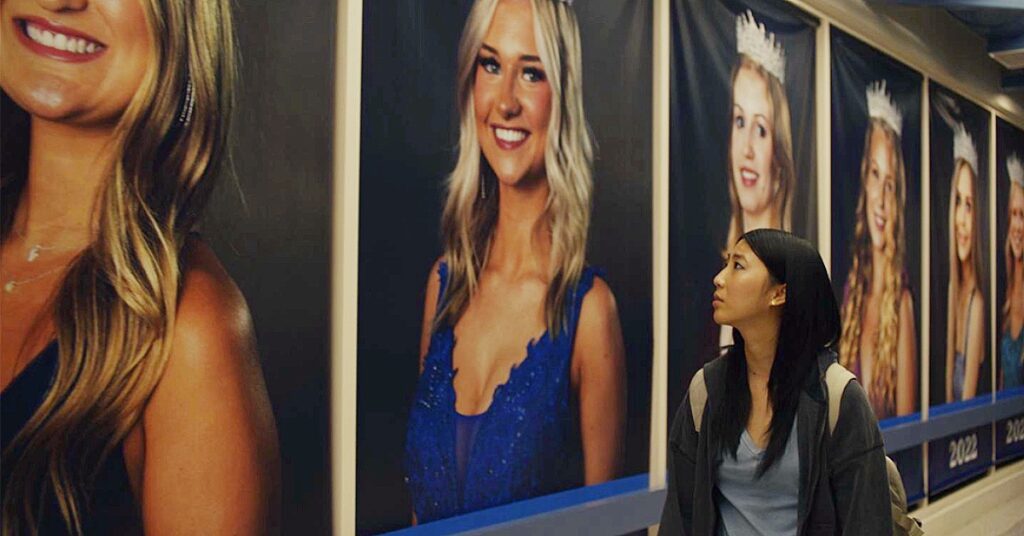
The writer(Amy Wang) put the onus squarely on the homogeneity of the good ol’ US-of-A which is probably why it is misperceived as lacking. Let's be clear, this film is on a well-defined path of exemplifying how anyone who is not of European descent is made to feel less than. If there was any confusion about that, there is a ‘commercial’ of sorts halfway through the film that sings out,”It’s good to be White”.
Throwing shade on conservatives isn’t the film’s only goal. Liberals are also shown the mirror of their selective allyship when Joan’s father is injured while cleaning the home of Harmony, (Elaine Hendrix) a White woman. With all of the ethnic art adorning the walls of her home in the background, she is overflowing with compassion for Brown folk a continent away but fails to show it for someone right next to her.
That’s a whole other movie.
While some critics and moviegoers were unable or unwilling to grasp its deeper concepts, the reality-bending satire succeeded in conveying the anxieties that some Black and Brown folks experience sometimes daily. One critic even suggested there was no nuance which is code for, “It didn’t take the time to try and make me feel comfortable with my racism.”
I digress.
As with most films, don’t listen to the critics. Make up your own mind and don’t shy away from the evocative themes that will challenge your world view whether you’re White, Black or Brown. Watch this film with your kids and don’t shy away from the ensuing conversation. I applaud Amy Wang for tackling this deeply personal and obviously traumatic subject.