Netflix’s recent Millie Bobby Brown vehicle, Enola Holmes 3, is a disappointing and confusing entry in the stellar Enola Holmesfranchise. Directed by Philip Barantini, the film stars Brown as Enola Holmes(estranged sister of Sherlock Holmes,) Henry Cavill as Sherlock Holmes, and Louis Partridge as her love interest, Viscount Tewkesbury. While it deserves credit for its exciting action scenes and attempts to expand the diversity of its Dickensian setting, the most recent entry in the series completely scuttles Enola’s underdog status from the first films that made her so charming and gave a touch of realism to the story of a young, unmarried woman living in London while self-employed as a detective.
Enola Holmes 3 opens with Enola on her way to her wedding to the Viscount of Tewkesbury. A dramatic scene ensues in which Enola must rip off her wedding accouterments and attack the man pursuing her carriage, who turns out to be Dr. Watson (Himesh Patel) asking for help because Sherlock has been kidnapped. In a flurry of flashbacks and narration to the camera, we follow Enola as she abandons her wedding, the hotel she’s staying at gets burned down, and her soon to be mother in law is kidnapped. With help from her mother (Helena Bonham-Carter), her pushover fiancé, the amenable Dr. Watson, and anticolonial Maltese freedom fighter (and comic relief) Mikiel Mizzi (Joe Azzopardi), she saves her loved ones and uncovers a conspiracy of silence around treasure plundered from Khost during the British invasion of Afghanistan. However, Enola’s character has changed dramatically since the first two films, and in some ways lost its effectiveness.
Enola (Brown) travels to her wedding before being stopped by Dr.Watson (Patel)
In the first two films, Enola was an underdog. In the first film, Enola Holmes, the titular character saves the Viscount of Tewkesbury from assassination as he was set to vote on a progressive reform bill. Throughout it, she flees imprisonment in a finishing school, finds her missing mother, and escapes the guardianship of her misogynistic brother Mycroft in order to set up a life for herself in London with the support of her radical suffragette mother. By the second film, she’s living unmarried and free, crushing on Tewkesbury, and supporting herself as a detective in a Victorian pastiche of modern 20-something aspirational living. It’s a little unrealistic, but it’s grounded by Enola’s pluck and intelligence that allow her to outsmart the suffocating social standards faced by women in Victorian England. Combined with the sequel’s plotline of Enola helping factory workers strike, the series established itself as one about an underdog helping other underdogs when no one, not even the Great and Good Sherlock Holmes himself, would intervene on their behalf.
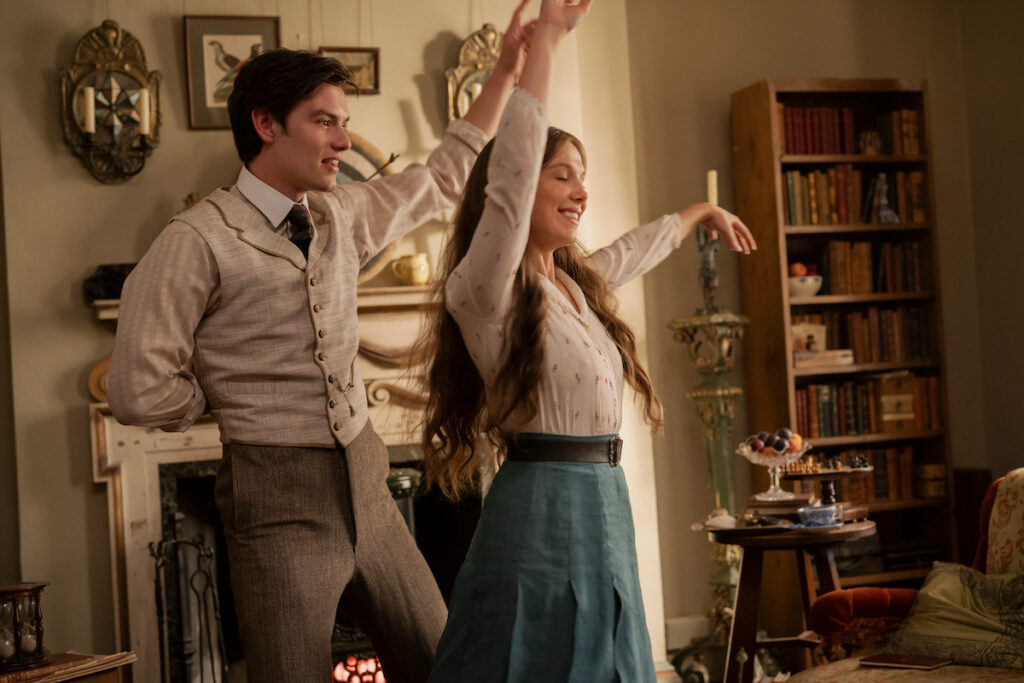
Enola in her London apartment with Viscount Tewkesbury (Partridge)
But by the latest entry in the series, Enola Holmes’ social status has changed. She’s about to marry into the family of a Lord, she’s on first-name terms with the esteemed Dr. Watson, her mother is on the run for terrorism associated with the women’s suffrage movement but everyone is cool with it, she’s finally on friendly terms with her popular brother Sherlock, and her detective business is largely accepted. Sure, she faces some derision from the Viscount’s old-money family, but it is those same family connections that drive the plot forward and allow Enola to investigate largely unimpeded. She abandons her expensive wedding with no interpersonal consequences, family connections to the governor help her get out of being questioned by Maltese authorities before she even sees a jail cell, and in the end of the film, Enola sees all the offending soldiers from the Battle of Khost arrested with the genial cooperation of the British administration in Malta.
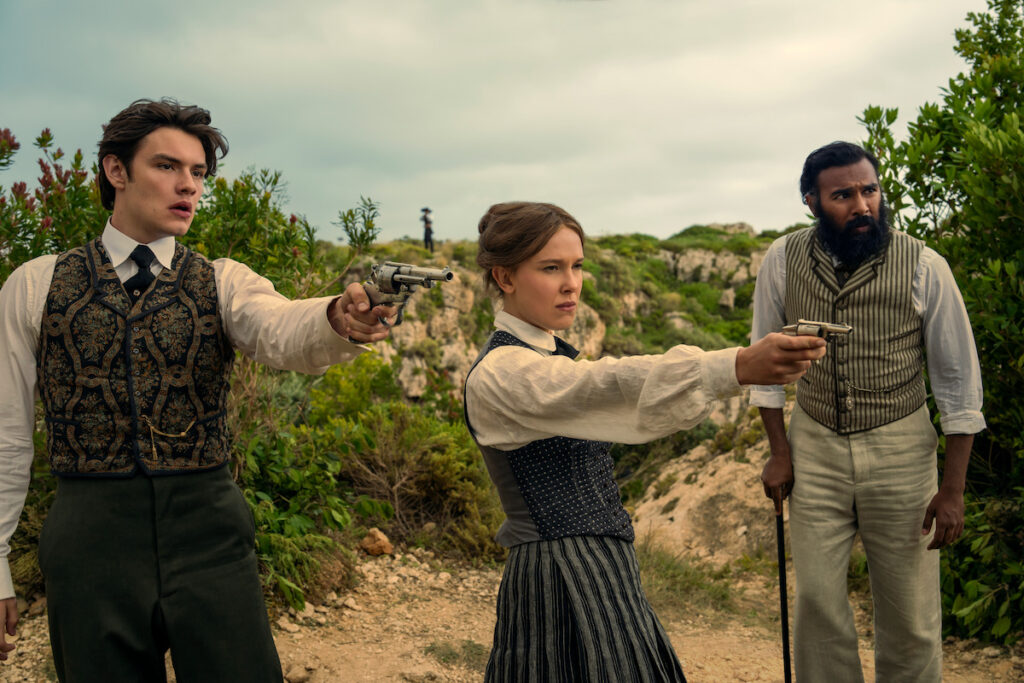
Enola, the Viscount, and Dr. Watson (Patel) confront Moriarty
While the lack of realism is perhaps a step too far, even for a YA film, the more damaging result of these choices by the filmmakers is the lack of stakes: a lack of commitment to the central thesis of Enola Holmes, that with bravery and intelligence the strictures of society can be outwitted if not overcome. That idea is weakened by the fact that in this movie, everyone of consequence is pretty much on board with Enola’s ideas and actions the entire time.
In Enola Holmes 3, Enola is further separated from her underdog roots and the world of Victorian London she has become so adept at navigating. Enola Holmes 3 takes place almost entirely in Malta, the exotic scene of Enola’s destination wedding. While in Victorian London she slums it with factory workers and fights assassins in dark alleyways, in Malta, Enola exists in the world of the upper class, even as she hunts down her brother. Despite the film’s gestures towards anticolonialism with the character of Mikiel, no effects of colonialism are ever seen in the film. We hear Mikiel say repeatedly that he wants a free Malta, Enola comes to agree with him, and she even befriends his guerrilla army of Maltese partisans, but never does the audience glimpse an ounce of the poverty of the colonized people or much of a glimpse of life outside of the fancy hotel the Viscount’s family is staying at.
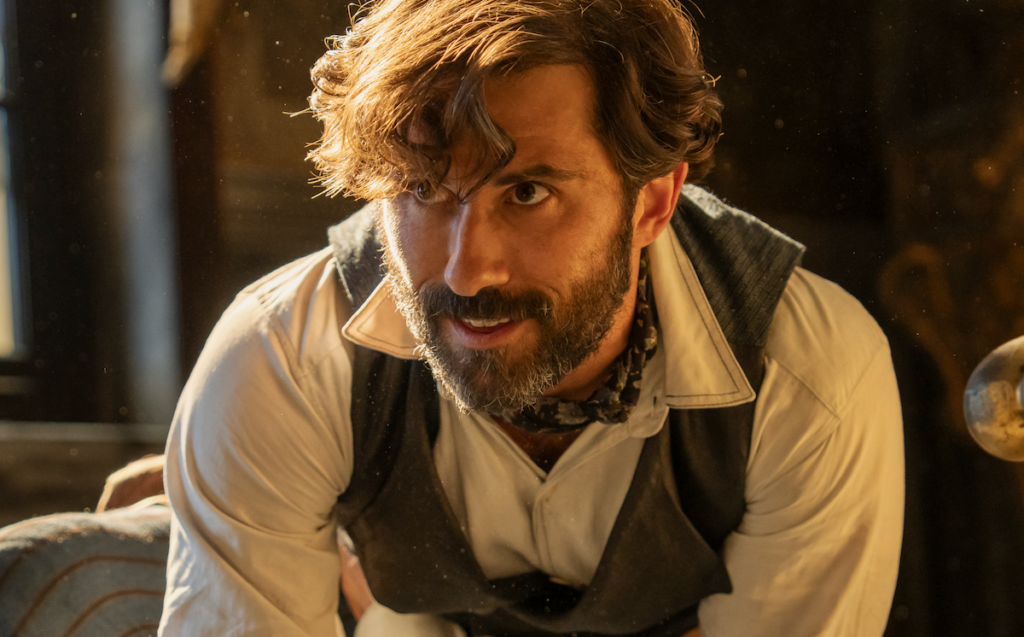
Mikiel Mizzi, (Azzopardi) Maltese freedom fighter
Not only does Enola Holmes 3 waste opportunities to actually explain colonialism rather than just dropping in characters who speak against it, the film also tries to turn the antagonist Professor Moriarty (Sharon Duncan-Brewster) into a morally grey character by using her to monologue about the personal responsibilities of the film’s main characters. “Always so superior,” Moriarty says after Enola demands the release of her brother. “Must you protect gold that is filthy with blood? Stained you as it stained that floppy boy whose dirty name you almost took. But then, what of the Holmes name? I wonder what privilege that is built on. Sugar? From Jamaica, perhaps? Silk or cotton from India? There are few British names that are not tarnished with the pain of its empire.”
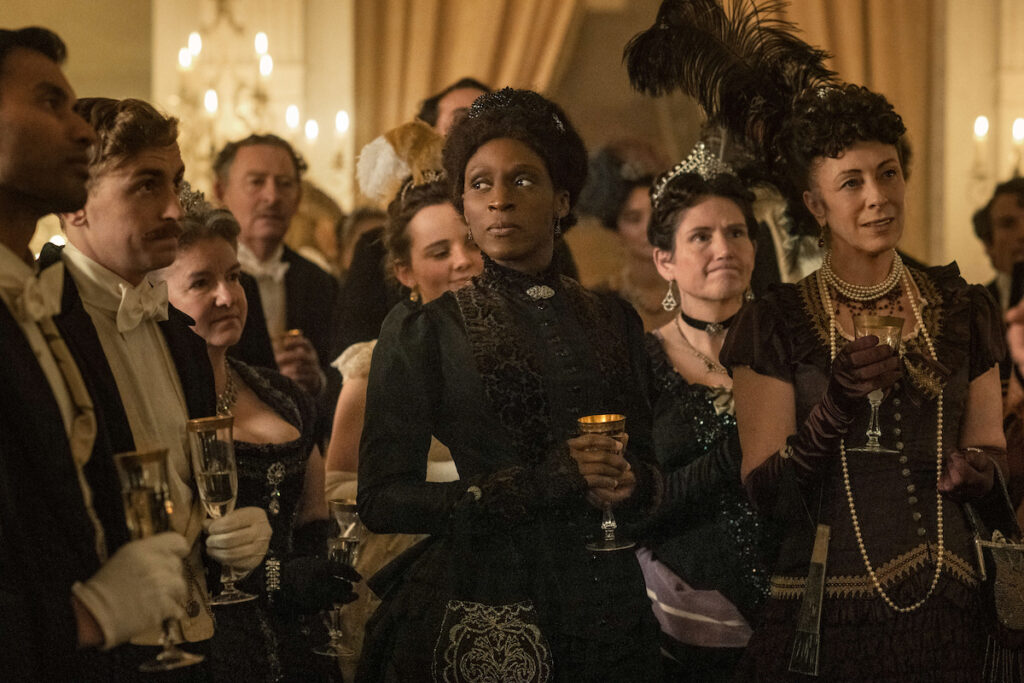
Professor Moriarty (Sharon Duncan-Brewster)
The implications of this are confusing. In the world of Enola Holmes 3, did slavery exist? Does Enola Holmes 3 take place in the same world as ours? If so, how does a diverse and largely colorblind society in London exist in the 19th century? While Enola Holmes 3’s diverse cast is certainly to its credit, the filmmakers’ shaky worldbuilding when it comes to rewriting racial history undermines the stories about colonialism it tries to tell. Combined with the out of the blue revelation that Tewkesbury is giving up his hereditary title, and thus ability to advocate for reform in the House of Lords, the movie concludes as a lackluster entry for the Enola Holmes series strung together by plucky one liners and action scenes rather than true moments of personal growth or consequence, as well as stumbling over the finish line in its attempts to address race and colonialism.