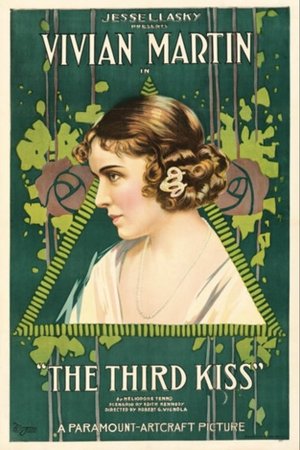
The Third Kiss (1919)
Missy, the heiress to her uncle's fortune, resolves to make atonement for the innocent lives lost when her uncle's box factory burns down because of his criminal carelessness. After her uncle dies, Missy disguises herself as an employee of the new factory and does settlement work where she meets Rupert Bawlf and his wife Cynthia. Rupert's friends Oliver Cloyne and Dr. Paton observe Rupert's infatuation with Missy and tell her that Rupert is the subject of gossip in society circles. Cloyne persuades Missy to wed him and avert scandal for the Bawlfs, and promises to divorce her later. After the honeymoon, Cloyne discovers Missy is an heiress. He kisses her twice and declares that if he kisses her a third time it will mean that he plans to keep her. Rupert is rejected by Missy and repents. Cloyne rescues Missy from a fire and gives her a third kiss that signifies their mutual love.

- / 5
PopScore
Representation
Pictures and Videos

Movie Information
Missy, the heiress to her uncle's fortune, resolves to make atonement for the innocent lives lost when her uncle's box factory burns down because of his criminal carelessness. After her uncle dies, Missy disguises herself as an employee of the new factory and does settlement work where she meets Rupert Bawlf and his wife Cynthia. Rupert's friends Oliver Cloyne and Dr. Paton observe Rupert's infatuation with Missy and tell her that Rupert is the subject of gossip in society circles. Cloyne persuades Missy to wed him and avert scandal for the Bawlfs, and promises to divorce her later. After the honeymoon, Cloyne discovers Missy is an heiress. He kisses her twice and declares that if he kisses her a third time it will mean that he plans to keep her. Rupert is rejected by Missy and repents. Cloyne rescues Missy from a fire and gives her a third kiss that signifies their mutual love.
Rating:
Genre:Comedy, Drama
Written By:Edith M. Kennedy, Heliodore Tenno
In Theaters:9/14/1919
Box Office:
Runtime:50 minutes
Studio:Famous Players-Lasky Corporation





Articles You May Like
Honey Don’t!: A Messy Queer but Mischievous Comedy
Honey Don't! is a chaotic queer noir that's part detective story, part midnight movie madness. Margaret Qualley is fantastic as the wise-cracking private eye Honey, with Aubrey Plaza and Chris Evans adding their own dry humor to the mix. The mystery itself is pretty loose, but the film makes up for it with crackling sexual tension, weird side characters, and razor-sharp dialogue. It's messy and uneven, but in the best possible way.
I Love You Forever—RomCom Turned Nightmare Relationship
I Love You Forever, marketed as a “subversive” romantic comedy is in fact a painful horror film about a young woman deep in the throes of an abusive relationship.
Searching for Identity in Iñárritu’s Bardo
The director's latest is a dreamlike exploration of a consciousness torn between two homelands, and the implications of history and memory suspended in limbo.
'Jack and Diane' Review: Wasted Potential
The plot could’ve really been interesting if the elements of lycanthropy was integrated with perhaps the struggle of identity of being LGBTQ+. It's an experience for so many that as they’re starting to realizing their true selves, they feel like a monster, especially if they come from unsupportive homes or communities. Instead, the horror and transformation elements seem thrown in without contemplation of how this could deepen the narrative.
Polarizing Polar: An Exploitation Film For the Modern Viewer
In the shadow of towering film production companies lived dozens of grindhouses, genres, and low-budget films deemed too “unclean” for the modern film audience.