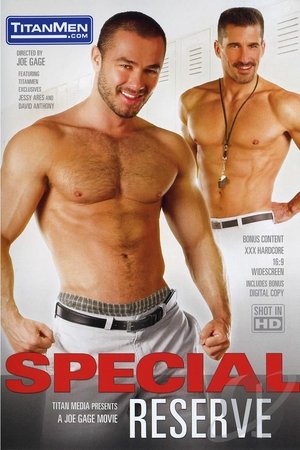
Special Reserve (2012)
Tense guy Jessie Coulter needs to loosen up, his body soon quivering in excitement from the full service offered by masseur Jessy Ares. "What's up, coach?" asks eager jock Kyle Quinn, who soon finds himself stuffed at both ends by aggressive athletes David Anthony and Race Cooper. And lastly, alpha businessman Jessy Ares takes full advantage of late interview candidate Kyle Quinn, who will do anything to get the job.

- / 5
PopScore
Representation
Pictures and Videos

Movie Information
Tense guy Jessie Coulter needs to loosen up, his body soon quivering in excitement from the full service offered by masseur Jessy Ares. "What's up, coach?" asks eager jock Kyle Quinn, who soon finds himself stuffed at both ends by aggressive athletes David Anthony and Race Cooper. And lastly, alpha businessman Jessy Ares takes full advantage of late interview candidate Kyle Quinn, who will do anything to get the job.
Rating:NC-17
Genre:
Written By:
In Theaters:1/1/2012
Box Office:
Runtime:100 minutes
Studio:Titan Media





Articles You May Like
What Netflix's “Shadow and Bone” Gets Right and Wrong with the Books’ Diversity
Netflix’s Shadow and Bone has a complicated relationship with race. It has a diverse cast, but not without its problems. Based on Leigh Bardugo’s two book series, the show features characters from the Shadow and Bone trilogy, which is very straight and white, and the Six of Crows duology, which is much more diverse. When bringing together a cast and writing about these characters, the team behind the show expanded upon some of the representation missing from the first trilogy, then seemed to take away representation from the duology. Shadow and Bone seems to play a bit of a push and pull game when it comes to portraying diversity onscreen.
Review: 'Sylvie's Love' is Beautiful in its Simplicity
The film is a simple love story reminiscent of stories like The Notebook released in 2004. Sylvie and Robert are rarely actually together in the film, however; time and circumstance keep them away from each other, and the audience waits with bated breath to see them find one another over and over.
Erik Was Right: Revisiting Magneto In a Post-Killmonger World
Voicemails for Isabelle is Heartwarming and Hilarious
Netflix’s new rom-com, Voicemails for Isabelle (dir. Leah McKendrick), isn’t just heartwarming, funny, and an achievement in female directing - it’s also an instant classic. Following 20-something aspiring baker Jill (Zoey Deutch), Voicemails for Isabelle tells a story of grief, self-discovery, and fateful connections. Ever since her beloved sister Izzy’s (Ciara Bravo) death, Jill has been leaving her hilarious, extremely TMI voicemails about her chaotic love life and miserable day job as a prep cook. Little does she know that a handsome and unsatisfied real estate agent in her hometown has inherited the number and practically fallen in love with her by listening to her stories.
In The Heights: The Case for Diversifying Diverse Films
In the film adaptation, director Jon M. Chu turns each musical number into a massive show stopper, with grand set pieces and a wealth of diverse dancers. Yet, in this attempt to show reverence for the people of the Washington Heights barrio, Chu, or maybe more specifically those in charge of casting, left out a crucial part of the community, Afro-Latinos.