
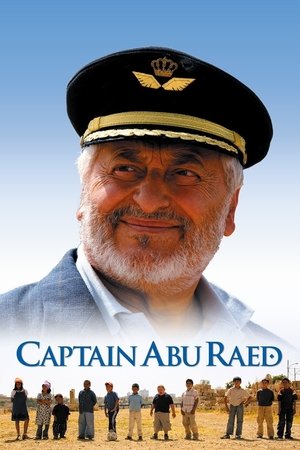
Captain Abu Raed (2009)
Abu Raed is an old airport janitor who has always yearned to travel the world but has never been able to afford it. One day, he finds an old discarded pilot's hat, and discovers a calling: a group of children in his poor neighborhood assume he's an airline captain and beg him to share stories of the world outside of Amman, Jordan. Through imaginary tales, a friendship forms, and Abu Raed is soon faced with the grim realities of the children's home life. Thus he takes it upon himself to make a difference in their lives.

- / 5
PopScore
Representation
Pictures and Videos

Movie Information
Abu Raed is an old airport janitor who has always yearned to travel the world but has never been able to afford it. One day, he finds an old discarded pilot's hat, and discovers a calling: a group of children in his poor neighborhood assume he's an airline captain and beg him to share stories of the world outside of Amman, Jordan. Through imaginary tales, a friendship forms, and Abu Raed is soon faced with the grim realities of the children's home life. Thus he takes it upon himself to make a difference in their lives.
Rating:
Genre:Drama
Written By:Amin Matalqa
In Theaters:8/14/2009
Box Office:
Runtime:102 minutes
Studio:Paper and Pen Films, GigaPix Studios



Articles You May Like
TIFF ‘22 Coverage: ‘Triangle of Sadness’
Ruben Östlund muses about his characters, “As soon as you get close to a person, you see them as just another human being”. It is widely recognized that aboard the luxury yacht in ‘Triangle of Sadness’, the different groups of people represent a small society as a commentary on classism and gender binaries.
‘Vacation Friends’ is Funny yet Forgettable
In a film where a Black couple is framed to be the lead characters, they still managed to get shuffled off to the sidelines. The enthusiastic cast delivers well on goofy bits- but can only go so far before they begin to fall flat.
Bergman Island Offers Ingmar Bergman’s Take on the Twenty First Century In Its Own Way
It’s the most loving tribute to cinema and to Ingmar Bergman, set in world that feels so habitable that I felt like only re-watching this for eternity, because of how inviting it looks and feels.
'The Platform’ - a Horror/Thriller that Paralleled the Pandemic
"The Platform" is horror and science fiction film doubling as a visual commentary on capitalism and economic inequality. The movie is not for the faint of heart nor the viewer hoping for political neutrality in their film's depth.
Trans Allegories in Film: 'Robots' (2005)
Animation as a medium of storytelling can be thought to be open to all ages and as I hope my readings will reveal, they could be interpreted as transgender stories.