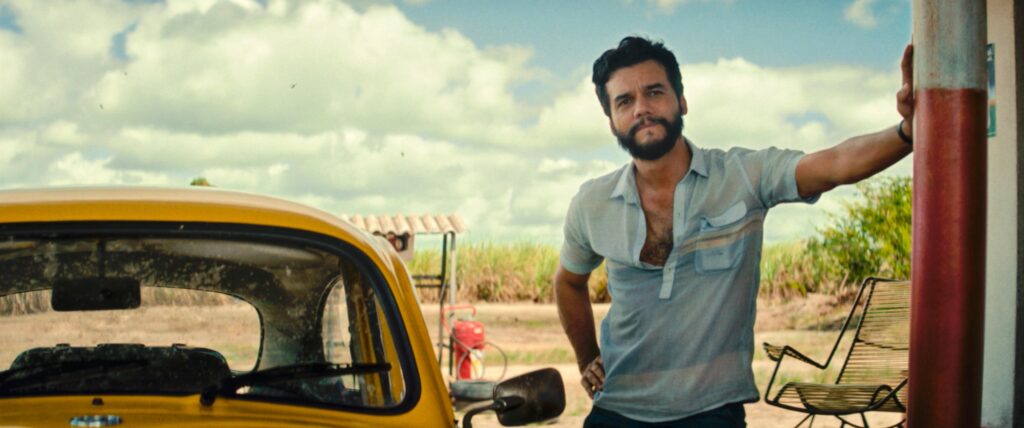
In Kleber Mendonça Filho’s The Secret Agent, the sociopolitical climate of Brazil in 1977 is depicted by the exchange of characters on screen, verbal and nonverbal. It didn’t introduce the circumstance of the protagonist, Marcelo/Armando, at the beginning and didn’t mention that “Marcelo” was a fake name until the middle of the film. Instead, a sequence at the gas station opened the film, introducing the situation of Brazil in the 70s. Besides Marcelo, who arrived in a signature yellow Volkswagen Beetle, other characters in this scene only appeared once. During this sequence, the camera kept panning to a dead body facing down on the ground as futile attempts to seize comprehension. A police duo only stopped to harass Marcelo for bribery because they assumed someone in a Beetle would get some money, neglecting the corpse. Some carnival-goers passed by in a car and decided not to stop due to the sight of police. On the side, the stray dogs constantly tried to nudge the body, while only the kind shop owner was cursing them away again and again. The bribery and corruption of the public departments are embodied in the mannerisms of those twisted individuals in public and private sectors. The military dictatorship isn’t explicit in language but in the contingencies of persons’ lives. As a subplot, an imaginary story of one hairy leg mixed the fiction and the real life, which made a sarcastic commentary on the police violence and corruption.
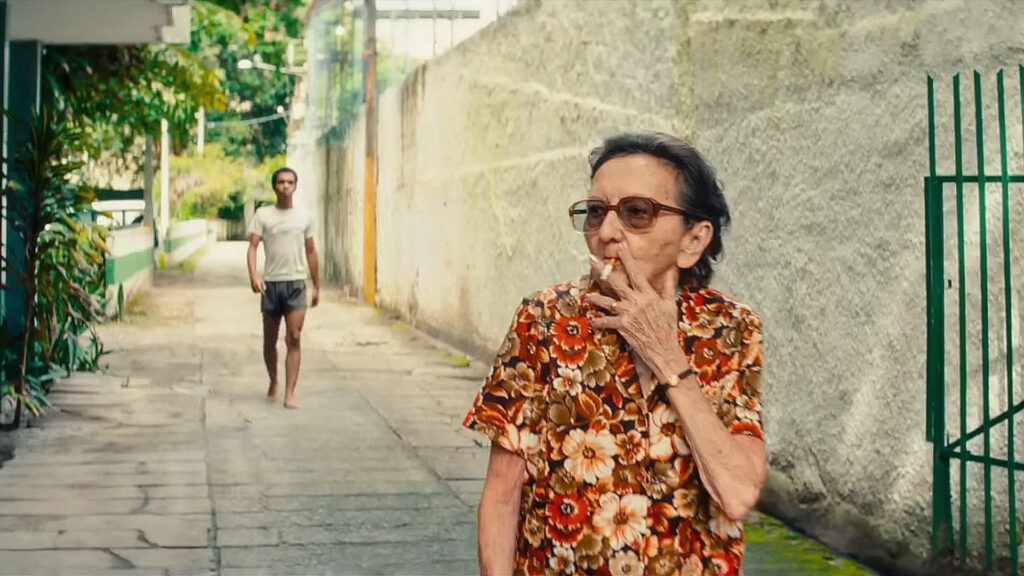
It’s revealed later in the film that the reason why Armando was on the run was because of his conflict with the corporate head who illegally took over the public-funded research at the university. He got assistance from Elza, who was a political resistance leader. It’s significant that the film is told from the view of a regular scientist who was assassinated because he stood firmly in their way of oppression, not from the view of Elza. The resistance was not only held by the activists, but folks in different fields had the dignity to go against the grain, along with all the people surrounding them. Even Armando’s new colleagues, father-in-law, and young son are all involved in his resistance in various degrees. The film portrayed them as lively individuals and showcased their joy at the difficult moments. In the lovely community of a wise and energetic elder woman, Dona Sebastiana, other residents and a disabled cat were also in her care, and even though their reasons and their future were unknown, the spirit was felt in the light-hearted conversations.
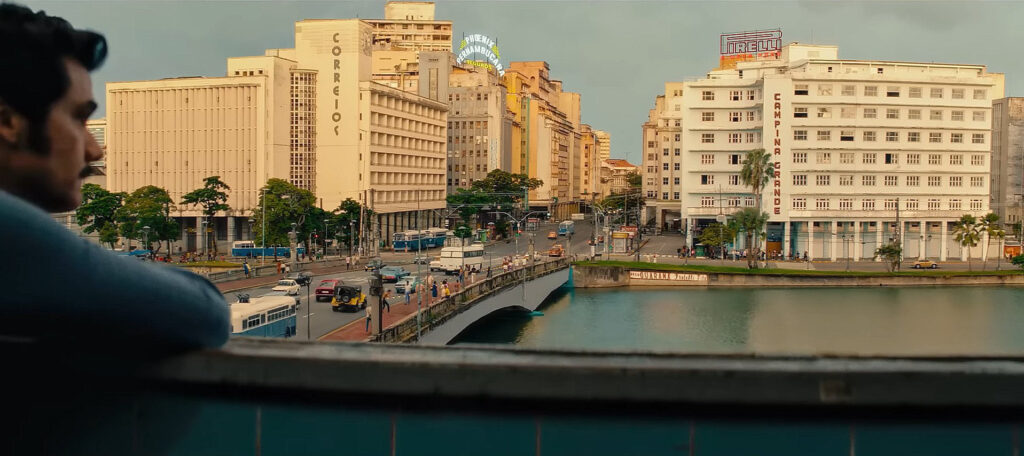
The atmosphere of Recife in the 70s was breezing through the screen with the jazz, funk, bossa nova, the colorful shirts with opened buttons, and the sweat on people’s skin. We can see the diversity of the Brazilian population, the people’s lives in the lower social class, and how the different systems were operated, including newspaper publishing, hospitals, universities, police stations, and so on. In the cinema office for the projectionist, where Armando’s father-in-law worked, Armando sat by a large window, through which we saw the urban landscape of Recife. The view was simply breathtaking.
The film presents the story development from the views of various characters simultaneously and also a retrospective view from the future as the young researchers were trying to put the puzzles together while listening to the cassette tapes in the archive. It ends with the student, Flavia, reaching out to Armando’s son, Fernando, out of curiosity and compassion. Fernando, played by the same actor, has become a middle-aged doctor and worked in the hospital at the address of the demolished cinema. Fernando admitted he actually didn’t have the memory of his father. The audience could only see the death of Armando in a singular faded photo from a scan of a newspaper report, leaving out a climatic scenario after the nerve-wracking chase sequence. When Armando worked in the city office, he tried to find the evidence that could prove his deceased mother’s identity, which was lost to her social disadvantage. The attempts to retrieve the history, despite the absence in the archives and memories, are across generations. The film left a long-lasting flavor of sorrow and also a line of hope and warmth. When Wagner Moura, who played Marcelo/Armando and adult Fernando, accepted the award for Best Actor in a Motion Picture at the Golden Globes, he said, ‘if trauma can be passed along generations, values can too.’ In the difficult moments, we shall remember those numerous other similar moments that had happened in history and the people and the community before us who had chosen dignity and love.