"Exhibiting Forgiveness" Exhibits Excellence
‘Exhibiting Forgiveness’ seeks to ask one question, “What do you do when your parents are the source of your pain?”

In 1975, ABC aired a new type of crime drama that showcased the LAPD’s Special Weapons And Tactics division – otherwise known as S.W.A.T. This team functioned as the go-to squad to handle highly violent and dangerous situations. The leader of this team was Dan ‘Hondo’ Harrelson played by Steve Forrest, a Caucasian actor. It only lasted two seasons.
There is usually at least one Black actor on the principal cast of any given cop show. The 1975 version of S.W.A.T. featured Rod Perry as David ‘Deacon’ Kay. In 2003 they revived the franchise with a theatrical release. Having come off the success of Shaft, in this iteration, Hondo is played by Samuel L. Jackson.
To expand on Jackson’s version of Hondo, Shamar Moore was cast in the 2017 series as the leader of 20-Squad and ‘Deacon’ is played by non-melanated actor Jay Harrington. With producers Justin Lin (Fast And Furious) and Shawn Ryan, this series leans into the 21st century by making the team even more diverse and adds David Lim and Lina Esco. So now we have a “United Colors Of Bennetton” cast that reflects one of the most diverse cities in the US. All joking aside, the principal casting is a breath of fresh air. The guest stars were diverse as well, although the rest of S.W.A.T, not so much.
The stories are sentimentalized, melodramatic fare with impassioned acting – and sometimes overacting. There is sometimes this duality in the storytelling I picked up on throughout its run. While there was clearly some acknowledgement of diversity, there was still some racism and sexism baked in. I think the writers were trying to show how a person can grow to be more compassionate towards people who don’t look or believe like them. Great. However, there was confusion with some characterizations.
Deacon is written as a practicing Catholic, yet he often shows little-to-no compassion for the African-American community. Sometimes Hondo calls him out and sometimes it feels normalized. Also, Chris, the only woman in S.W.A.T. who consistently pushes for more women officers, complains about the fitness testing being too difficult when more women begin to apply to S.W.A.T. Academy. With all of her protestations of “women can do anything men can do” season after season, this was a head-scratcher.
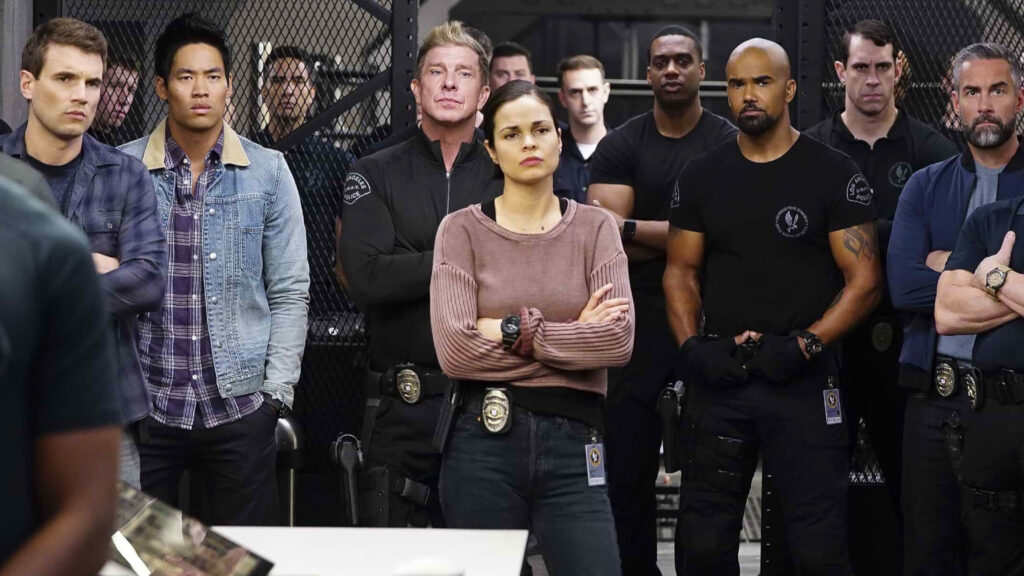
There was a minor but glaring detail I only noticed when I dove into the 1975 series. Hondo was originally a lieutenant. In the theatrical version and newer series, Hondo is a sergeant. Obviously, there was some decision made here. Also, another minor detail, Hondo always looks angry. An absolute racial trope.
In the first episode when Hondo is promoted to team leader, everyone is surprised and they make it very clear that Deacon is just as capable as Hondo to lead the team. For several seasons under a sense of entitlement, Deacon and his wife hold a grudge about him being passed over. Once again, this practicing Catholic acts in a manner contrary to his faith and displays no humility or forgiveness.
If it wasn’t for Hondo being African-American, I don’t think I would have continued to watch past the first few seasons. Hondo drives the socio-political tenor of the series and keeps the bigots in check. It’s also one of the few times we see a Black man in the lead role of a crime drama. This is the only reason I keep coming back.
As police procedurals go, it lives up to the name. No matter how difficult the case is, they always seem to wrap it up by the end of their shift. It’s formulaic, contrived and not very realistic. Its only saving grace, apart from the diverse casting, is the performances which are generally good. It’s no NYPD Blue but it’s action-packed and a good source of adrenaline.