Pearl Review - Mia Goth's Twisted Delusions of Grandeur
While subverting the conventions of Golden Age cinema with the characteristics of a slasher, Pearl studies the delusions of grandeur inspired by the movies.


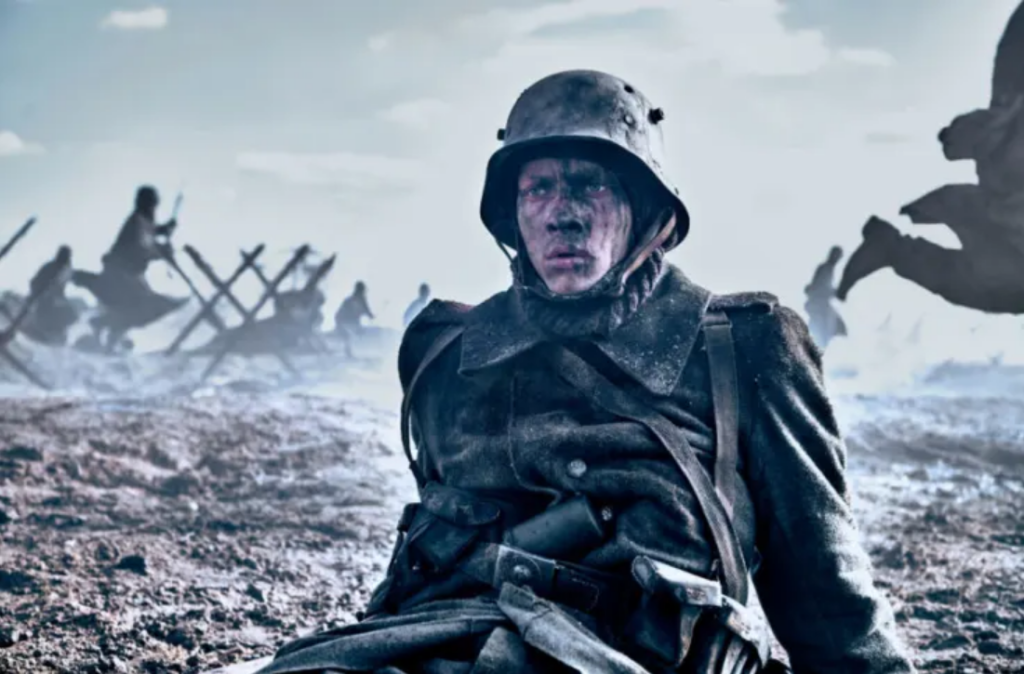 Paul (Felix Kammerer) witnesses the atrocities of war up close.[/caption]
In lieu of a conventional arc of action, the film focuses on the war’s human toll, both individual and collective. With little narrative motivation bestowed upon Paul and co., the film assumes a sort of flatlined feeling, as if a happy resolution was never an option. Whether by their own hand or the enemies’, the inevitability of the boys-turned-pawns’ demise is sealed under the command of egotistical military leaders. The ticking clock of the armistice, by the end of the film, underlines the big question inherent in Remarque’s novel: “what was any of this worth?” Ordering a final surge fifteen minutes before the armistice is to begin so that Germany can end the war with a victory—does this justify the casualties incurred?
The sentiments of an anti-war film are not new concepts but are nonetheless vital additions alongside the gung-ho pictures that often lack self-awareness. AQotWF serves more as a recapitulation of a nearly 100-year-old story dished for modern times. The film is about as diverse as you would expect the 1918 Franco-German frontlines to be, and the film’s attempts at humanizing its characters can feel forced and unnecessary within its thematic futility.
As an anti-war film, AQotWF emulates the grisly reality deployed to similar ends in Come and See and (more thematically than in content) The Painted Bird; innocence and humanity are beaten to a bloody pulp under tank treads and mortar shelling, and men are reduced to animals. The film starkly juxtaposes the soldiers’ gruesome experiences against the experiences of those calling the shots, playing war games, and negotiating surrenders while they comment on the lack of fresh pastries in a train dining car and feed their guard dogs meat scraps. (Food is also a recurring motif: the film opens with suckling foxes, and the soldiers’ appetite is mentioned throughout; they are ravenous enough to enjoy raw eggs out of a tin cup, as well as French provisions in a trench mid-attack). What makes AQotWF an effective anti-war film is the way it paints the senseless horrors of such an experience. The film affects the tolls of the war, both mental and physical, rather than romanticize the glory forged in what, at its root, is a massacre fought over a few feet of No Man’s Land, hardly moving the line an inch.
Though the film has been in production since 2020, its release on Netflix coincides with Russia’s mass conscription meant to fuel the ongoing invasion of Ukraine. We need not look any further than a power-hungry despot shrugging off mounting casualties in the name of national pride to find a contemporary, real-world parallel for the film, and consider the notion that war and violence never abate, they only adapt.
Paul (Felix Kammerer) witnesses the atrocities of war up close.[/caption]
In lieu of a conventional arc of action, the film focuses on the war’s human toll, both individual and collective. With little narrative motivation bestowed upon Paul and co., the film assumes a sort of flatlined feeling, as if a happy resolution was never an option. Whether by their own hand or the enemies’, the inevitability of the boys-turned-pawns’ demise is sealed under the command of egotistical military leaders. The ticking clock of the armistice, by the end of the film, underlines the big question inherent in Remarque’s novel: “what was any of this worth?” Ordering a final surge fifteen minutes before the armistice is to begin so that Germany can end the war with a victory—does this justify the casualties incurred?
The sentiments of an anti-war film are not new concepts but are nonetheless vital additions alongside the gung-ho pictures that often lack self-awareness. AQotWF serves more as a recapitulation of a nearly 100-year-old story dished for modern times. The film is about as diverse as you would expect the 1918 Franco-German frontlines to be, and the film’s attempts at humanizing its characters can feel forced and unnecessary within its thematic futility.
As an anti-war film, AQotWF emulates the grisly reality deployed to similar ends in Come and See and (more thematically than in content) The Painted Bird; innocence and humanity are beaten to a bloody pulp under tank treads and mortar shelling, and men are reduced to animals. The film starkly juxtaposes the soldiers’ gruesome experiences against the experiences of those calling the shots, playing war games, and negotiating surrenders while they comment on the lack of fresh pastries in a train dining car and feed their guard dogs meat scraps. (Food is also a recurring motif: the film opens with suckling foxes, and the soldiers’ appetite is mentioned throughout; they are ravenous enough to enjoy raw eggs out of a tin cup, as well as French provisions in a trench mid-attack). What makes AQotWF an effective anti-war film is the way it paints the senseless horrors of such an experience. The film affects the tolls of the war, both mental and physical, rather than romanticize the glory forged in what, at its root, is a massacre fought over a few feet of No Man’s Land, hardly moving the line an inch.
Though the film has been in production since 2020, its release on Netflix coincides with Russia’s mass conscription meant to fuel the ongoing invasion of Ukraine. We need not look any further than a power-hungry despot shrugging off mounting casualties in the name of national pride to find a contemporary, real-world parallel for the film, and consider the notion that war and violence never abate, they only adapt.